
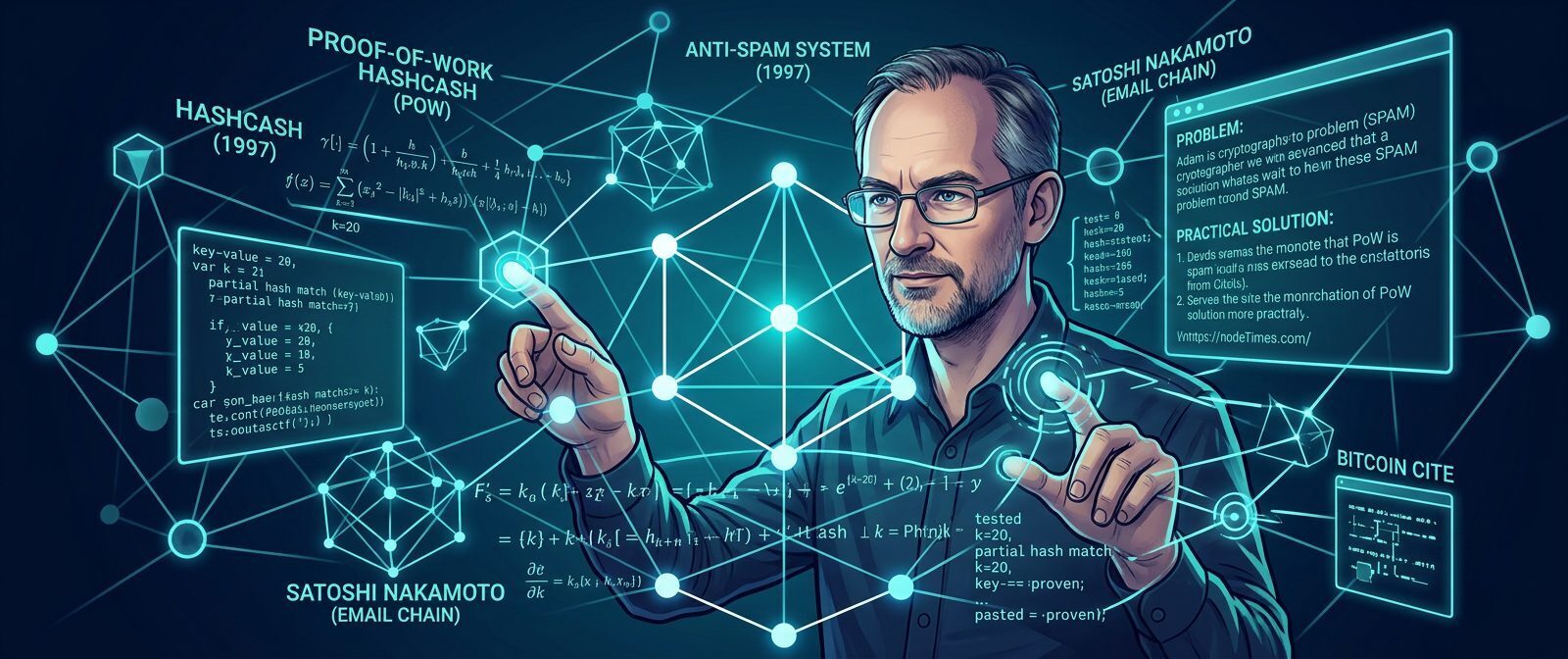



Long before Bitcoin became a global financial system, before mining farms filled warehouses and hash rates were measured in exahashes, a British cryptographer was trying to solve a much simpler problem. Email spam.
Adam Back did not set out to design the security engine of a decentralized monetary network. In the late 1990s he was working on abuse prevention on the internet. His idea was simple. Sending a message should require a small amount of computational work.
That small idea eventually became one of the foundations of Bitcoin.
If Nick Szabo explored the theory of digital scarcity, Adam Back showed how computation could enforce it.
Adam Back was born in London in 1970. He grew up at the moment when personal computers were slowly entering everyday life. For many children of that era computers were toys or curiosities. For Back they quickly became intellectual puzzles.
Programming fascinated him early. Cryptography fascinated him even more. It combined mathematics, computer science, and a philosophical question that would define much of his career. How can people interact securely without needing to trust each other?
Back later studied computer science at the University of Exeter in the United Kingdom. During those years the internet was still young. Many of the protocols and norms that now define the digital world were still evolving.
For Back the internet was not only a technical system. It was also a social experiment.
In the early 1990s he became involved with the cypherpunk mailing list, one of the most influential intellectual communities in the history of digital privacy.
The cypherpunks were not an organization. They were programmers, mathematicians, and activists connected by a shared belief. Privacy should not depend on governments or corporations. It should be protected by cryptography.
Among the people participating in those discussions were future pioneers of digital money and decentralized systems. Names such as Nick Szabo, Wei Dai, and Hal Finney appeared regularly in the threads.
The conversations were technical, philosophical, sometimes chaotic. But they formed a unique laboratory of ideas. Concepts like anonymous digital cash, proof of work, and decentralized trust were debated there years before they became real systems.
Back was one of the most technically focused voices in that environment.
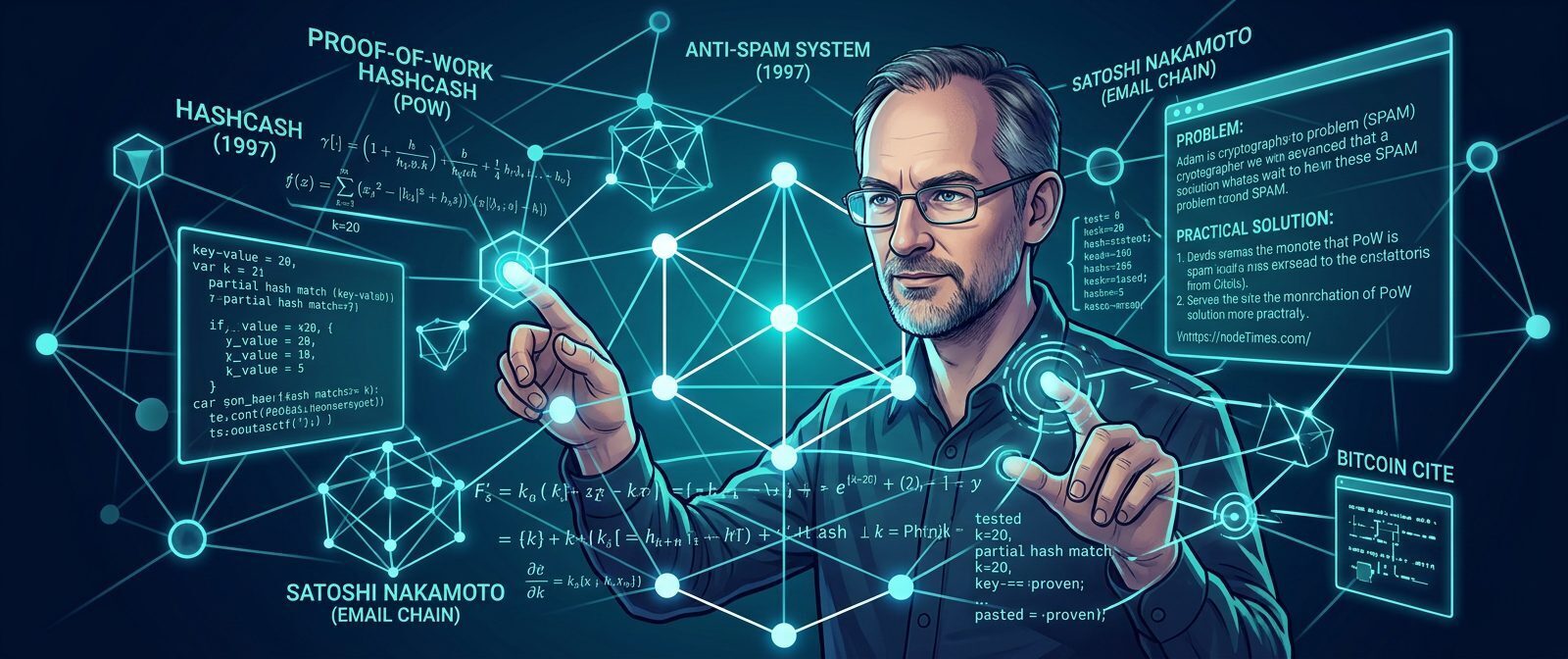
In 1997 he published a proposal called Hashcash.
The internet at that time was already struggling with spam. Email could be sent almost for free, which meant bad actors could send millions of messages at no cost.
Back proposed a different model. Before sending an email, the sender’s computer should solve a small cryptographic puzzle. The work would be easy to verify but slightly expensive to produce.
For an ordinary user sending a few messages the cost would be negligible. For a spammer sending millions it would become prohibitive.
Back described the mechanism clearly.
“Hashcash is a proof-of-work system used to limit email spam and denial-of-service attacks.”
The concept introduced a powerful principle. Computational work could function as a scarce resource in digital systems.
More importantly, proof of work could regulate behavior without central control.
When Satoshi Nakamoto released the Bitcoin whitepaper in 2008, Hashcash appeared directly in the list of references.
Bitcoin adapted the idea in a new way. Instead of limiting spam, proof of work would secure a distributed ledger and determine how new coins entered circulation.
The mining process in Bitcoin is essentially a large scale application of the same principle. Participants compete to solve cryptographic puzzles. The work secures the network.
Hashcash had quietly become one of the building blocks of a new financial architecture.
Unlike many figures in the cryptocurrency industry, Adam Back never pursued public fame. His career has been shaped more by engineering work than by media presence.
People who worked with him often describe him as analytical, calm, and extremely precise. He prefers technical discussion to speculation. His communication style reflects the culture of early cryptographers. Ideas should stand on their own merit.
This temperament sometimes places him slightly outside the louder parts of the crypto ecosystem. Yet it also reflects the mindset that helped shape the original cypherpunk movement.
In 2014 Back became CEO of Blockstream, a company focused on Bitcoin infrastructure.
Under his leadership Blockstream has developed several important technologies. These include the Liquid Network, a Bitcoin sidechain designed for faster settlement between exchanges and institutions, and Blockstream Satellite, a system that broadcasts the Bitcoin blockchain from space. The satellite network allows Bitcoin nodes to receive blockchain data even without traditional internet access.
These projects reflect a broader philosophy. The resilience of Bitcoin depends on infrastructure that is distributed and difficult to censor.
Back has also become a consistent voice in discussions about the long term security model of Bitcoin.
He frequently emphasizes the importance of proof of work. In his view the physical cost embedded in computation creates a powerful economic defense mechanism. Attackers must spend real resources to influence the network.
He has summarized the philosophy in simple terms.
“Bitcoin is an engineering system. It improves through careful iteration.”
The statement reflects a broader belief. Complex systems evolve slowly. Security comes from discipline and incremental improvement.
In retrospect, Hashcash looks almost like a prototype for Bitcoin mining. Yet when Back created it he was solving a very specific technical problem.
Spam.
This pattern appears often in the history of technology. Foundational breakthroughs sometimes emerge from modest experiments. The engineers who design them may not realize their full impact for years.
Adam Back did not invent Bitcoin.
But he helped invent the mechanism that allows Bitcoin to exist.
And sometimes that is exactly how technological revolutions begin. Quietly. Through a small idea that proves something new is possible.

Top comments (0)