



Who Actually Leads, Where Russia Stands, and Whether the World Can Move Beyond Nvidia?
The global AI race is often told as a simple story: a handful of chatbot brands, a few giant chipmakers, and a planet rushing into the future at the same speed. Reality is harsher. The market is already highly unequal. The United States and China sit in a category of their own. A second tier of countries competes through talent, industrial policy, or infrastructure. Russia is not in that leading group. And the deeper battle is no longer just about the best model. It is about who controls compute, chips, cloud capacity, and the software stack that makes modern AI possible.
The AI race is not a level playing field
A serious assessment of national AI strength cannot rely on one metric alone. Counting papers is not enough. Counting patents is not enough. Counting startups is not enough. Real AI power comes from the combination of frontier research, compute infrastructure, private capital, talent, deployment capacity, and state strategy. That is why Stanford’s AI Index and Global AI Vibrancy work remain useful reference points: they measure not just noise, but the depth of an ecosystem.
Once you look at the market that way, a clear pattern emerges. The world is not witnessing ten equal powers in AI. It is seeing two systemic leaders, a crowded second tier, and a long tail of countries trying not to become dependent consumers of foreign models and foreign infrastructure.
A practical 0–100 scale of national AI strength
Using Stanford’s latest comparative picture as the backbone and normalizing everything to the United States = 100, the landscape becomes easier to read:
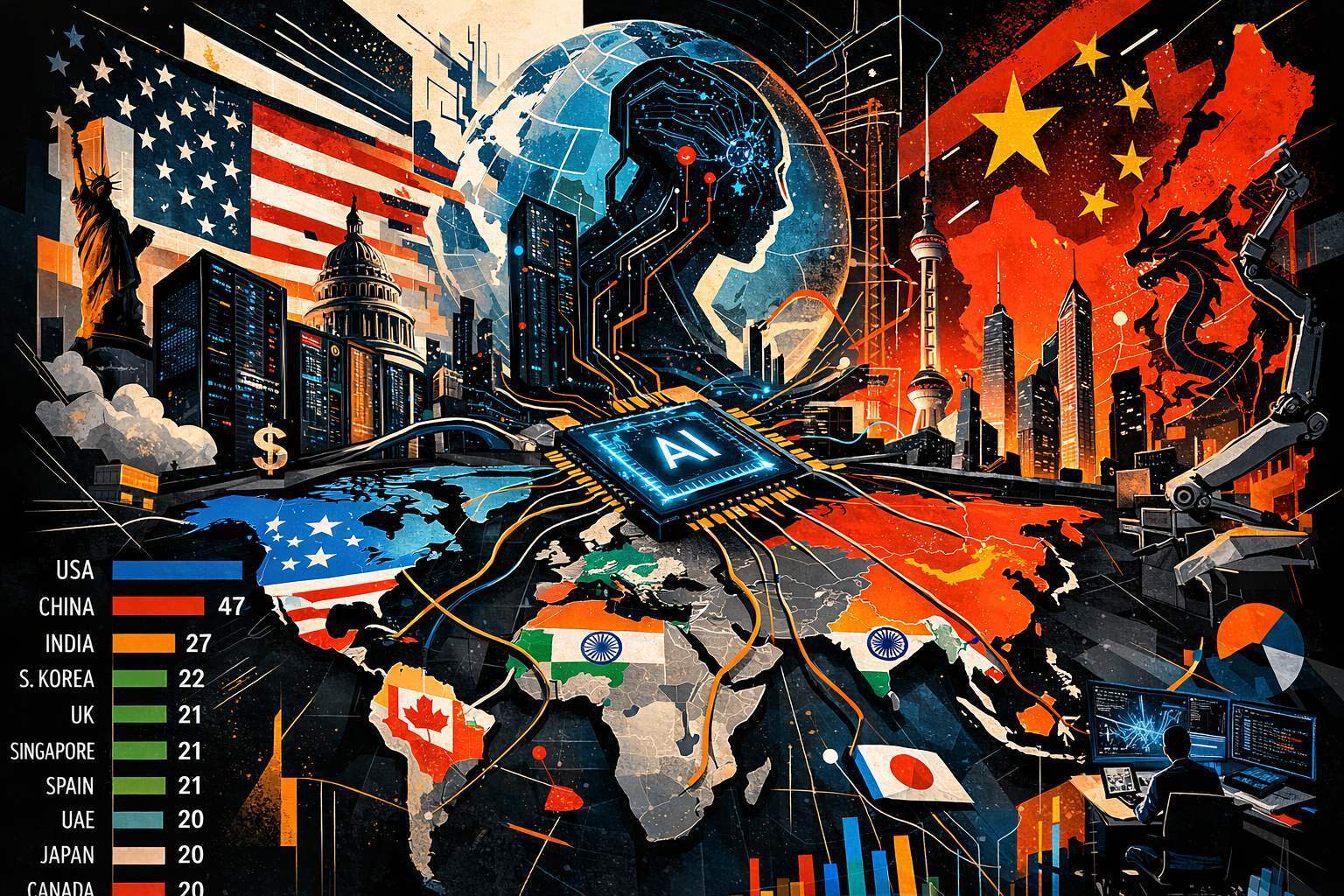
- United States — 100
- China — 47
- India — 27
- South Korea — 22
- United Kingdom — 21
- Singapore — 21
- Spain — 21
- UAE — 20
- Japan — 20
- Canada — 20
This is not an absolute truth machine. It is a visual way to show the relative weight of national AI ecosystems. But even as a simplification, it reveals something important: the gap is enormous. The United States is not just ahead. It is ahead by enough to shape the rules of the market. China is the only country with enough scale to act as a systemic challenger. Everyone else is meaningfully smaller.
Why the United States remains the undisputed leader
America’s lead is not built on one company or one product cycle. It comes from control over multiple layers of the stack at once. Stanford reports that in 2024, U.S.-based institutions produced 40 notable AI models, compared with 15 in China and 3 in Europe. U.S. private AI investment reached $109.1 billion in 2024, nearly 12 times China’s level and 24 times the United Kingdom’s.
That matters because AI dominance is no longer just about having good researchers. It is about the full cycle: frontier labs, hyperscale cloud, chip supply, software platforms, enterprise adoption, and consumer distribution. The United States has OpenAI, Anthropic, Google, Meta, Microsoft, Nvidia, and the cloud infrastructure behind them. That is not just an ecosystem. It is the operating system of the current AI market.
China is the only systemic challenger, but it plays a different game
China’s strength is structured differently. If the United States dominates the top of the commercial and platform stack, China pushes through industrial scale, patent density, research volume, and state-backed deployment. Stanford notes that China continues to lead in AI publications and patents, while the quality gap between Chinese and American models narrowed sharply in 2024 on major benchmarks.
WIPO’s generative AI patent landscape makes the point even sharper: Chinese inventors were responsible for more than 38,000 GenAI patent families between 2014 and 2023, roughly six times the U.S. figure. That does not automatically mean China has the best models. It does mean the country is building a huge engineering base and treating AI as a broad industrial technology, not just a chatbot market.
So the U.S.–China contrast is simple. America leads at the highest-value global platform layer. China is strongest as the large-scale industrial mobilizer. One controls more of the premium stack. The other is building depth, speed, and national alignment.
The second tier is real, but it is fragmented
Below the top two, the field gets messy. India is rising fast because of talent and market scale, but still lacks the same frontier compute depth. South Korea is strong in industrial AI and patent activity. The United Kingdom remains powerful in research and AI safety, but is much weaker than the U.S. in capital and infrastructure. Singapore is small but unusually dense in capability. The UAE is buying strategic position through infrastructure and national prioritization. Japan and Canada remain serious players through industry and research.
This matters for one reason: most of these countries have pieces of the puzzle, but not the full stack. They may have talent without chips, capital without a domestic model ecosystem, or strong policy without enough compute. That is the difference between being competitive and being sovereign.
Where Russia stands in this race
Here the sober answer is uncomfortable. Russia is not in the top tier, and it is not particularly close to the top ten either.
According to the Tortoise Global AI Index 2024, Russia ranks 31st out of 83 countries. Reuters also reported that Russia sits 31st of 83 on Tortoise’s index and 29th on Stanford’s AI Vibrancy ranking, behind not just the United States and China but also India and Brazil.
If we place Russia on the same practical 0–100 scale where the U.S. is 100, China is 47, and India is 27, Russia looks more like 8–12. That is an analytical approximation, not an official Stanford score in that exact format, but it fits the broader ranking picture. Russia is not competing with the first two tiers of global AI power. It is competing to remain relevant.
That does not mean Russia has no AI capabilities. It clearly does. Reuters notes that Russia’s strength lies in local talent and domestic models such as GigaChat and Yandex GPT, while policymakers keep emphasizing technological self-reliance. But the constraints are serious: sanctions, weaker access to advanced chips, a smaller compute base, lower private capital intensity, and a narrower commercial ecosystem. Those are not cosmetic weaknesses. They define the ceiling.
A fair comparison is this: Russia today is a regional AI player with capable companies and strong technical pockets, but not a country that currently shapes the global direction of frontier AI.
The deeper question: is the world really trapped by Nvidia?
This is where the story gets more interesting than rankings.
Many people assume modern AI is basically impossible without Nvidia GPUs. That is too simplistic. The better question is whether AI compute can be done without Nvidia specifically, and whether it can be done without GPU-like accelerators at all. Those are different questions.
The answer to the first is yes. The answer to the second is only partly. The market can move beyond Nvidia. It cannot easily move beyond highly parallel accelerators.
GPU dominance did not happen because GPUs are mystical AI machines. It happened because they combined three advantages at once: massive parallelism, mature developer tooling, and scale manufacturing. Nvidia’s moat is not just silicon. It is the surrounding ecosystem: CUDA, libraries, interconnects, deployment know-how, and developer habit. That is why replacing Nvidia is harder than shipping a fast chip. You have to replace an environment.
Why the Bitcoin mining analogy actually works
The comparison with Bitcoin mining is more useful than many people think.
Bitcoin moved from CPU → GPU → FPGA → ASIC because the workload was narrow and repeatable. Once the problem stabilized, specialization won. AI is following a related path, but with a major difference: the workload is far more diverse. Training large models, serving inference, handling multimodal systems, routing sparse architectures, and running edge AI are not the same thing. That makes a single universal “AI ASIC” much harder than an ASIC for SHA-256 mining. This is why the future of AI hardware is unlikely to converge into one device class. It is more likely to split into specialized layers.
Alternatives to Nvidia already exist
The important point is that the market is not standing still.
Google’s TPUs are the clearest proof that large-scale AI does not have to run on Nvidia chips alone. Large cloud and platform companies are also building their own custom ASICs to reduce dependence on Nvidia. Meanwhile, WIPO’s data and the broader patent race show that countries and firms are actively searching for differentiated compute architectures rather than accepting permanent lock-in.
This does not mean Nvidia is about to collapse. It means the monopoly pressure is already generating alternatives. The future likely belongs to a more segmented compute market:
- one class of hardware for frontier model training,
- another for inference at scale,
- another for edge and embedded AI,
- and nationally driven solutions for countries pursuing technological autonomy.
In other words, the likely outcome is not “the death of GPUs.” It is the end of the idea that one vendor should dominate every layer forever.
What countries like Russia should learn from this
For countries outside the top layer, trying to copy Nvidia head-on is probably the wrong move. The better strategy is more selective.
Focus on inference-oriented accelerators rather than trying to beat the global leaders in frontier training right away. Focus on model optimization so the same tasks can run on weaker or more specialized hardware. Build software compatibility layers because hardware without a usable stack is just an engineering trophy. Specialize by verticals such as industrial AI, speech, defense, surveillance, computer vision, or edge deployments. And most importantly, treat compute, models, infrastructure, and deployment as one system, not as separate battles.
That is the real sovereignty lesson of the AI era. Owning a model is not enough. Owning a chip is not enough. Owning a cloud is not enough. The countries that matter will be the ones that can stitch enough of the stack together to avoid becoming permanent tenants inside someone else’s platform.
Final takeaway
The global AI race is not mainly about who launches the loudest chatbot. It is about who controls the underlying stack: chips, cloud, energy, software ecosystems, and the ability to deploy AI across an economy. The United States leads because it controls more of that stack than anyone else. China is the only country with the scale to challenge it systemically. The second tier is crowded but fragmented. Russia, for now, sits outside the top group and closer to the problem of relevance than to the problem of leadership.
And the Nvidia question points to the next phase. AI compute will not remain a one-vendor story forever. But it also will not become magically decentralized overnight. The real shift will come through specialization: different chips for different workloads, different national strategies for different constraints, and a growing realization that compute is not just a technical issue anymore. It is geopolitical infrastructure.

Top comments (0)