
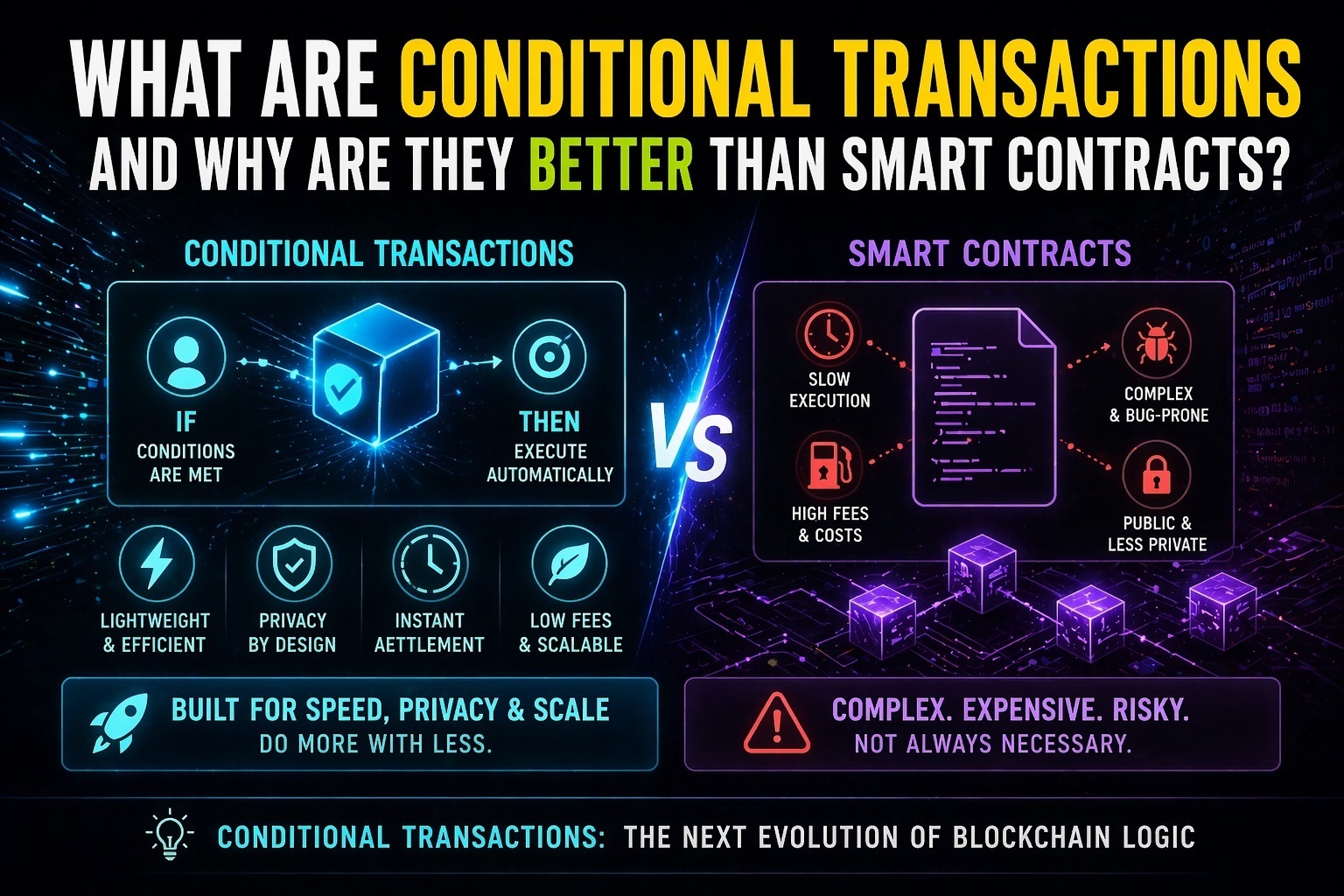

Conditional transactions are a Cellframe mechanism that lets you lock funds on the blockchain and release them only when predefined conditions are met. Unlike smart contracts, where logic is encoded in code that may contain bugs and requires separate auditing, conditional transactions work on a simple “lock → wait for fulfillment → unlock” principle. This eliminates entire classes of vulnerabilities – reentrancy, buffer overflows, logic errors – and requires no virtual machine (EVM/WASM) for execution. In Q1 2026 alone, smart contract exploits caused $86.2 million in losses, while conditional transactions in Cellframe have suffered zero exploits.
What Is a Conditional Transaction and How Does It Work?
A conditional transaction is a transaction whose output can only be spent when a specific condition is met. It does not need a smart contract – the condition is embedded directly into the transaction structure.
Technically, a conditional transaction locks funds on an address and simultaneously records the condition that must be fulfilled to unlock them. Only when the service provider confirms that the condition has been met do the funds transfer to them.
In the Cellframe ecosystem, conditional transactions replace smart contracts, offering a simpler and faster alternative that fully automates the payment process. Conditional transactions can be single interactions between a customer and a provider, or they can form a chain of multiple such transactions.
How a chain of conditional transactions works:
| Step | Action | Description |
|---|---|---|
| 1 | Customer creates the first transaction | Locks funds and defines the exchange conditions for services |
| 2 | Provider creates a second transaction | Allows receiving part or all of the amount after conditions are met |
| 3 | Using the remainder | If locked funds are not fully used, they can be reused to pay the same provider, choose another provider, or be returned to the wallet |
How It Works in Practice: Renting an Electric Car
Imagine you want to rent an electric car through a decentralised service on the blockchain. A conditional transaction makes this automatic, secure, and trustless.
How it works:
The customer creates a conditional transaction. They lock an amount equivalent to the rental fee and specify the condition: “Funds will be transferred to the provider when the car’s IoT sensor confirms that the trip is finished, the car is returned, and the mileage matches the tariff.”
The provider (car owner) creates a counter‑transaction. After the car’s return is confirmed, the funds are automatically transferred to their account.
If the sensor detects a violation (speeding, damage, excess mileage), the condition is not met, and the funds remain locked until the dispute is resolved.
Why this is safer than a smart contract: In a classic smart contract, the logic for releasing funds is written in code. Any mistake in that code can lead to loss of funds. A conditional transaction requires no code – the condition is verified by the network itself through a built‑in mechanism.
Conditional Transactions vs Smart Contracts: Escrow Example
An escrow service is a classic example where a third party holds funds until conditions are met. On a blockchain, this role can be played either by smart contracts or by conditional transactions. The difference is security.
Scenario: Buying an NFT for $10,000
Via a smart contract (Ethereum):
- Buyer and seller rely on the smart contract’s code, which locks funds and releases them after confirmation.
- Risks: reentrancy, logic errors, buffer overflows. In Q1 2026, escrow contract vulnerabilities led to millions in losses – from infinite draining via reentrancy attacks to the corruption of entire stablecoins. Six audited projects still lost $37.7 million due to code vulnerabilities.
Via a conditional transaction (Cellframe):
- The buyer creates a transaction locking $10,000 and specifies the condition: “Funds go to the seller when the NFT is transferred to the buyer’s address.”
- Condition verification happens at the protocol level – no code execution.
- Result: No code – no vulnerabilities.
In Cellframe, conditional transactions are already used for limit orders on the DEX, master node delegation, validator keys, and service payments.
Security Comparison: Smart Contracts vs Conditional Transactions
According to Hacken’s Q1 2026 report, smart contracts and related vulnerabilities caused tens of millions of dollars in damage. Cellframe’s conditional transactions – zero exploits.
| Vulnerability type | Q1 2026 losses | Cause |
|---|---|---|
| Smart contract exploits | $86.2 million | Code bugs, reentrancy, buffer overflows |
| Access control breaches | $71.9 million | Compromised keys, authorisation errors |
| Phishing & social engineering | $306 million | Human factor (not code‑related) |
| Conditional transactions (Cellframe) | $0 | No executable code – no vulnerabilities |
Hacken’s key conclusion: “the most expensive hacks happen outside the code.” But even those that happen inside the code hit wallets hard. Conditional transactions simply eliminate this entire risk category.
Smart contracts vs conditional transactions:
| Criterion | Smart contracts (Ethereum) | Conditional transactions (Cellframe) |
|---|---|---|
| Logic execution | Virtual machine (EVM/WASM) | Built‑in protocol |
| Audit required | For every contract | Not required (mechanism is built‑in) |
| Vulnerabilities | Reentrancy, overflows, logic bugs | None (no code) |
| Gas/fees | High (EVM computation) | Low (native execution) |
| Single point of failure | Contract address – central target | No single address |
Performance: Why Conditional Transactions Are Faster
Smart contracts run through a virtual machine (EVM or WASM), adding several layers of abstraction. Conditional transactions execute natively – no bytecode interpretation, no gas calculations, no overhead.
Performance comparison:
| Parameter | Smart contracts (EVM) | Conditional transactions (Cellframe) |
|---|---|---|
| Execution environment | Virtual machine | Native (C core) |
| Overhead | High (bytecode interpretation) | Low (direct execution) |
| Parallelism | Limited | Two‑layer sharding – thousands of Cells |
| Fees | ~200k gas for complex logic | Fixed, low |
Cellframe uses two‑layer sharding: the first layer consists of independent L1 blockchains for different services; the second layer is dynamic Cells, each processing its own transactions in parallel. This allows conditional transactions to scale almost infinitely.
Where Are Conditional Transactions Used in Cellframe?
Conditional transactions are not an experimental feature – they are a working mechanism already powering key services in the Cellframe ecosystem.
| Application | Description |
|---|---|
| Cellframe DEX | Limit orders are implemented as conditional transactions. Funds stay locked until the price reaches the specified level. |
| Master node delegation | Transferring validation rights is handled via a chain of conditional transactions. |
| Validator keys | Block signing and reward distribution use conditional transactions. |
| Shared Funds | Multi‑signature collective accounts protected by post‑quantum cryptography. |
What’s Happening with Conditional Transactions in 2026?
Cellframe is actively integrating conditional transactions with WASM smart contracts – not as a replacement, but as a complement. Heavy logic goes into WASM, while secure fund storage stays in conditional transactions.
In Cellframe Node 6.1 (scheduled for mid‑2026), conditional transactions will be tightly integrated with WASM smart contracts. This will allow developers to create complex, high‑performance workflows by chaining transitional transactions together. Thanks to highly optimised C blocks, these smart contracts can execute much faster than traditional approaches.
Additionally, the upcoming hard fork in Cellframe Node 6.1 will significantly reduce the resource requirements for master nodes, accelerating network processing and node synchronisation.
Glossary
| Term | Definition |
|---|---|
| Conditional transaction | A transaction whose output can only be spent when a predefined condition is met. Cellframe’s built‑in mechanism that replaces smart contracts. |
| Smart contract | A program stored on a blockchain that runs on a virtual machine (EVM/WASM). Contains business logic as code. |
| Reentrancy attack | An attack where a malicious contract repeatedly calls a function before the previous call finishes, draining funds. A classic smart contract vulnerability. |
| Escrow | A mechanism where a third party holds funds until transaction conditions are met. On blockchains, implemented via smart contracts or conditional transactions. |
| WASM (WebAssembly) | A binary instruction format used as a high‑performance smart contract execution environment. Faster than EVM. |
| Two‑layer sharding | Cellframe’s architecture: first layer – independent L1 blockchains; second layer – dynamic Cells for parallel transaction processing. |
| t‑dApps | Transactional decentralised applications on Cellframe that run directly on nodes without smart contracts. |
| Hacken | A blockchain security company that publishes quarterly reports on Web3 hacks and vulnerabilities. |
Summary
Cellframe’s conditional transactions are not just an alternative to smart contracts – they are a different approach to blockchain programmability, where logic is not written as code but embedded directly into the transaction structure.
Why conditional transactions are better than smart contracts:
| Aspect | Why better |
|---|---|
| Security | No executable code – no reentrancy, buffer overflow, or logic error vulnerabilities |
| Auditing | No need to audit each contract – the mechanism is built into the protocol |
| Performance | Native execution without a virtual machine + two‑layer sharding |
| Fees | No gas calculation for complex logic – fixed low fees |
| Simplicity | No need to learn Solidity or Rust – conditions are set via a standard interface |
While smart contracts continue to lose tens of millions of dollars to vulnerabilities, Cellframe’s conditional transactions operate without a single exploit. They are not meant to replace smart contracts everywhere – but for simple, predictable, and secure payment automation, conditional transactions offer a superior solution.



Top comments (0)