

Disclaimer (NFA): This material is for educational and analytical purposes only. I do not provide advice on buying, selling, or holding assets. You make all decisions independently.
When 10,000 BTC was paid for a pizza in 2010, few thought about the threats. Now, with rising prices and institutional money, the crypto world has transformed into a Wild West, where code replaces cowboys and phishing links replace bullets.
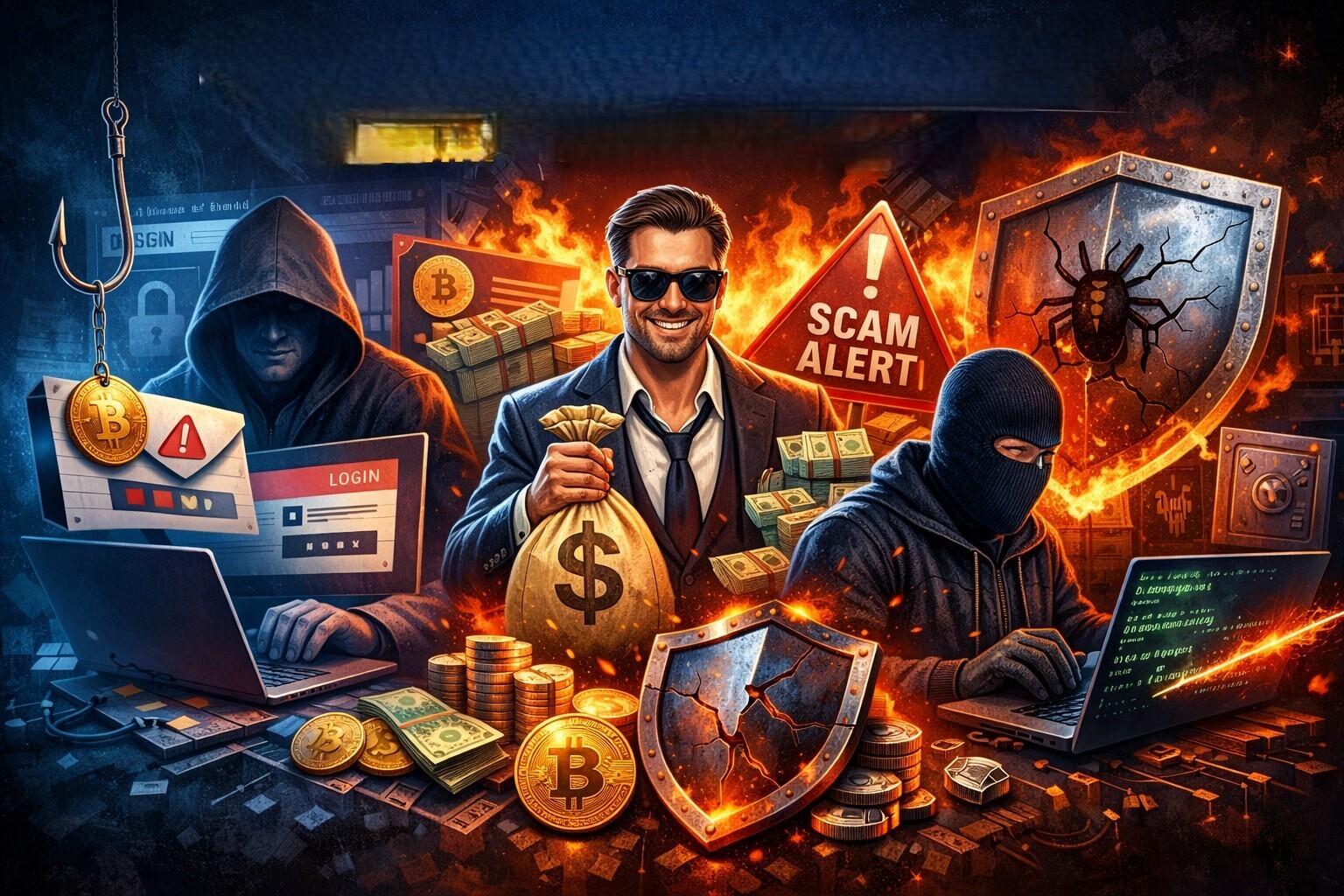
We will examine three main attack vectors:
Phishing (deception of consciousness),
Scam (fraudulent trust) and
Exploits (code deception).
These are not interchangeable concepts, but three different tools that attackers combine.
1. PHISHING: HUNT FOR YOUR "KEYS"
What is it?
Phishing is social engineering. The attacker doesn't hack the blockchain (that's nearly impossible), they hack you. You voluntarily give them sensitive data.
What it looks like in practice.
Imagine: you receive an email from " MetaMask ." It states that "due to a security update, your wallet will be blocked." You are asked to "urgently verify your account." The button leads to a website that looks exactly like the original. But the address bar differs by one letter: metamask.io vs metamask.xyz .
Enter your seed phrase (a secret 12 or 24 words). Done. Your wallet will be empty in a minute.
Modern mutations of phishing:
• ICE Phishing : An attack via fake "support" representatives on Telegram or Discord . An "admin" writes to you: "Your account has been hacked, please send me your seed phrase to roll back the transaction immediately."
• DNS Hack : Hackers take over a website's real domain (e.g. Curve Finance ). You go to the usual address, but it's fake.
How to protect yourself?
Never, do you hear me, never enter your seed phrase anywhere except into a freshly installed wallet. Not even Satoshi himself. Nakamoto won't ask you for your password. Use hardware wallets ( Ledger / Trezor ) – they physically can't transmit your seed online.
2. SCAM: WHEN CRYPT TURNED INTO A CIRCUS
What is it?
A scam is a fraudulent scheme with zero hacking. They lie to you, you believe them, and transfer your money. It's a good old "Ponzi scheme" on steroids.
The main types of scams in 2025:
A) Rug Pull the rug:
A new token is created (e.g., PepeElonMoon ). Aggressive marketing occurs, and sales are blocked for ordinary investors. When liquidity is reached (e.g., 1 million USDT), the creator uses a hidden function in the smart contract and withdraws all the funds. The token drops to zero.
B) Pig Butchering ("pig fattening")
: A beautiful girl/successful trader texts you with a "wrong number." A friendship/romance develops. Two weeks later, the other person says, "I know a hole in the Bybit exchange ; let's transfer your money." Your first $1,000 deposit is returned with a $200 "profit." You deposit $50,000—that's it. The exchange website disappears, along with your "friend."
How to protect yourself?
The golden rule: if a stranger writes to you about crypto with returns higher than bank rates , it's 100% a scam . Protocols with real returns ( staking , farming ) don't require personal communication.
3. EXPLOITS: CODE BUGS ARE LIKE A DOOR FOR BURGLARS
What is it?
An exploit is the use of a software vulnerability in a smart contract or protocol itself. There's no trickery involved. The hacker simply "pulls" money through an unprotected door.
The technology (I'll explain it simply).
Imagine a bank safe with an electronic lock. The lock operates according to the instructions: "If you enter the code 1234, open the door." But the programmer made a mistake: "If you enter the code 1234 or any other code starting with 1, open the door." A hacker discovers this error and empties the safe.
Historical examples:
• Reentrancy attack (2016, The DAO): A hacker forced a contract to reissue ether without updating the balance. Damage: $60 million. Led to a hard fork . Ethereum .
• Flash Loan attacks: An attacker takes out an interest-free loan for a million dollars for one second (such technology exists), manipulates the price on one exchange, and sells it on another. In one second, they steal $10 million. Example: the Euler attack Finance in 2023 ($197 million).
How to protect yourself?
The average user is almost powerless. The only way is to avoid storing all your money in "raw" (unverified) protocols. See TVL ( Total Value Locked (TVL) – the total amount of money in the protocol. The higher the TVL, the more audits the project has undergone. And give the new protocol six months to develop – hackers love fresh targets.
**
FINAL THREAT MATRIX**
Type threats Sacrifice Target hacker Yours home protection
Phishing You and yours brain Steal a seed phrase Do not enter data anywhere except in a cold wallet.
Scam Yours emotions (FOMO, greed ) Force translate money voluntarily Don't trust, verify ( DYOR ) rule
Exploit Smart contract Error in the code Use only large, seasoned protocols
In traditional finance, you're protected by law and insurance. In crypto, you're the bank, the security guard, and the insurance agent. Lose your keys? No money. Transfer money to a scammer's address? The transaction can't be reversed.
So rule #1: if something doesn't go according to plan (they ask for a seed , offer a 5% daily return, the contract looks suspicious), get out . It's better to miss the "X" than to lose everything. Only the paranoid survive in crypto.



Top comments (0)