
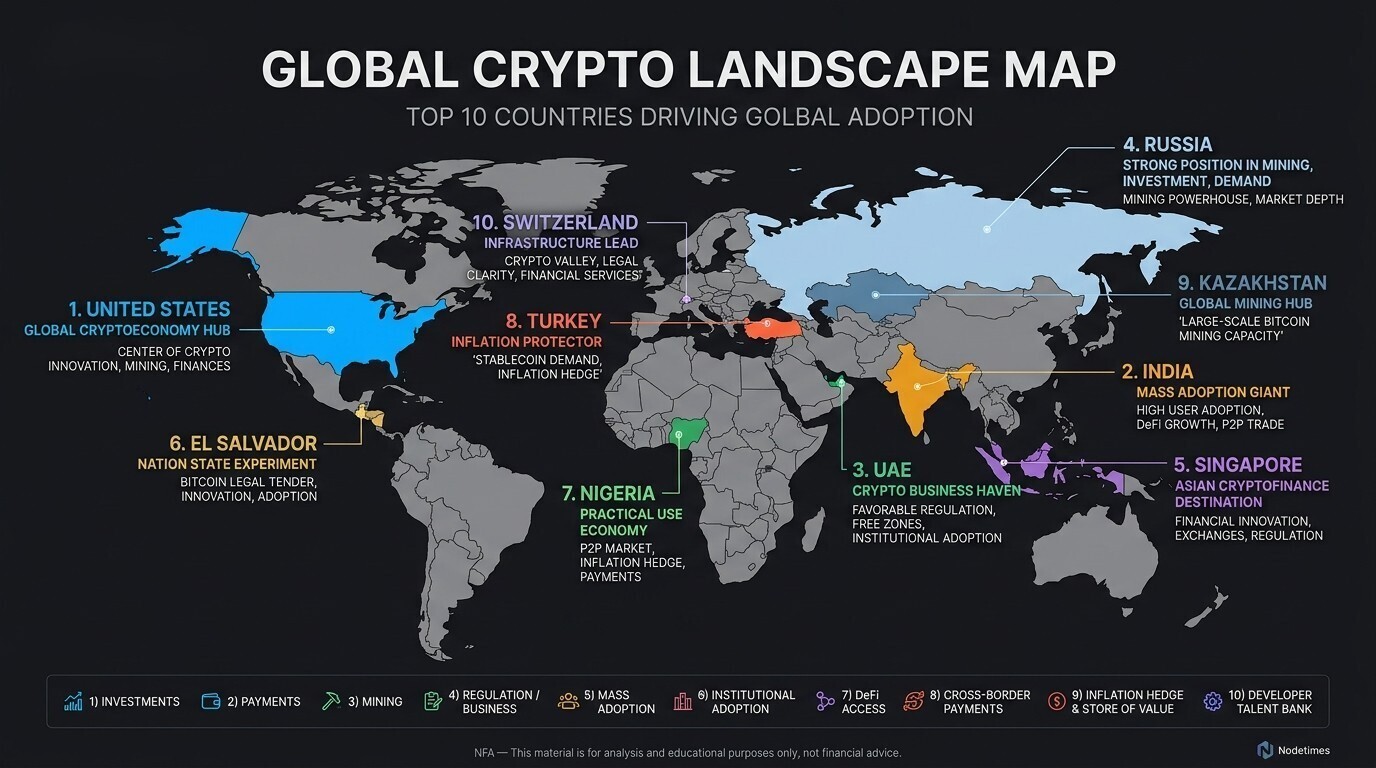



Today, cryptocurrency is no longer just about speculating on the Bitcoin price. In some countries, it's used for transfers and payments, in others, as a hedge against inflation, and in others, an entire industry has grown around it: mining, crypto exchanges , wallets, payment services, and funds. Therefore, when we talk about the "most crypto-involved " countries, it's important to look at not just one indicator, but several at once.
Three main criteria were taken into account for this rating :
- How actively is crypto used in real life?
- How deeply is it integrated into the investment environment?
- Does the country have a significant role in mining?
Plus – how clearly is the regulation structured there and how developed is the crypto business .
HOW DO YOU KNOW WHICH COUNTRY IS
STRONGER IN CRYPT?
There's no universal table that says, "Here are the 10 most crypto-active countries in the world." The reason is simple: the crypto market is too diverse.
Some countries lead in user numbers. Others in capital. Still others in Bitcoin mining. Therefore, for a more accurate picture, it's common to look at several sources at once: the global crypto adoption index from Chainalysis , crypto ownership estimates from Triple -A, and mining data from Cambridge. Center for Alternative Finance , as well as local statistics from exchanges, regulators, and research platforms
When all of this is put together, it creates a pretty clear map of the global crypto landscape .
1. The USA is the main center of the global cryptoeconomy
If you look at crypto as an industry, the US is the undisputed number one today.
The largest exchanges, funds, ETF issuers, custodians (i.e., digital asset storage services), mining companies, and infrastructure developers are concentrated here. Following the mining ban in China, the United States has become the largest Bitcoin mining hub. According to the Cambridge Centre for Alternative Finance, the country has, at various times, accounted for approximately 35-40% of the global hashrate —that is, the total computing power of the Bitcoin network.
Moreover, the US market has become the main channel for big money inflows into crypto in recent years. A particular milestone was the launch of spot Bitcoin ETFs, which opened access to BTC to a wide range of investors through the familiar exchange infrastructure.
Why the US is number one: capital, regulation, mining, and institutional demand converge here.
2. INDIA – A GIANT OF MASS CRYPTO ADOPTION
While the US leads in terms of money and infrastructure, India is one of the world leaders in terms of user interest.
According to Chainalysis , India has consistently ranked among the leaders in global crypto adoption in recent years , particularly in the retail segment. This is unsurprising: a huge audience, a habit of digital payments, high interest in new financial instruments, and a vibrant fintech market.
Yes, the country does have a downside: strict tax policies on crypto transactions have significantly cooled the domestic legal market. But it's precisely in terms of population engagement that India remains one of the strongest players in the world.
3. The UAE is a country that has focused on crypto business.
The UAE, primarily Dubai and Abu Dhabi, have become one of the world's leading crypto hubs in just a few years .
The Emirates' strength lies not in everyday cryptocurrency use or mining, but in something else: the country has created a clear and convenient environment for crypto companies . Exchanges, funds, Web3 startups, market makers , and infrastructure projects are opening here. For global businesses, it is currently one of the most convenient jurisdictions.
Against a backdrop of more stringent and unpredictable regulation in a number of other countries, the UAE has benefited from speed, clarity of rules, and a willingness to attract industry.
4. RUSSIA – A STRONG POSITION DUE TO MINING, INVESTMENTS AND REAL DEMAND
Russia is one of the largest Bitcoin mining centers. Since miners left China, the country has regularly ranked among the leaders in hashrate , typically ranking in the top three or five, depending on the period and calculation methodology. Russia has clear advantages for this: relatively cheap electricity in some regions, a cold climate, and access to industrial infrastructure.
The country has historically seen high interest in digital assets from private investors. Precise estimates vary, but they suggest millions of users and significant transaction volumes.
Thirdly, amid sanctions pressure, cryptocurrency in Russia has begun to be discussed not only as an investment but also as a potential cross-border payment tool. This doesn't mean that cryptocurrencies have already replaced traditional international payment mechanisms, but the demand for such solutions has clearly increased.
Russia's main problem is that for a long time, the market grew faster than the rules dictated. But based on a combination of factors—mining, user interest, capital, and practical demand—Russia remains among the most engaged countries.
5. SINGAPORE – ASIA'S CRYPTOFINANCE SHOWCASE
Singapore may not be as noisy as Dubai, but its reputation in the crypto world is very high.
It is one of Asia's leading hubs for funds, fintech companies, family offices, and investment vehicles working with digital assets. The country is known for its straightforward licensing and generally cautious, yet non-hostile, approach to the industry.
Singapore isn't a story about crypto-craze , but about quality infrastructure, legal certainty, and a mature capital market.
6. EL SALVADOR – THE BOLDEST STATE EXPERIMENT
El Salvador cannot be ignored, even if its economy is not comparable to the United States, India or Russia in size.
The country became the first in the world to make Bitcoin legal tender in 2021. Since then, the government has begun building a payment infrastructure, promoting BTC as part of the financial system, and even establishing a public Bitcoin reserve.
It must be admitted: expectations and reality didn't fully align. Bitcoin hasn't become a universal means of daily payment for all residents. But the very fact that an entire country has integrated crypto into its national strategy makes El Salvador a unique case.
*7. NIGERIA – CRYPTO AS A TOOL OF SURVIVAL, NOT FASHION
*
Nigeria is one of the most striking examples of how cryptocurrency is becoming part of the everyday economy.
Demand for stablecoins —digital assets pegged to the dollar—is particularly high here. The reason is clear: people want a more convenient way to store value, transfer money, and circumvent the limitations of the traditional financial system. According to Chainalysis , sub-Saharan African countries, including Nigeria, remain among the most active in terms of real-world user adoption of crypto.
This is an important point: for many Nigerians, crypto is not an exotic commodity or a trading toy, but a working financial instrument.
- Türkiye – WHEN INFLATION PUSHES PEOPLE INTO DIGITAL ASSETS
Turkey has been among the countries with very high levels of cryptocurrency ownership for several years now . The reason for this is primarily macroeconomic.
High inflation and pressure on the national currency have made Bitcoin, and especially dollar-denominated stablecoins, a viable alternative for some people. When people are unsure of the lira's purchasing power, interest in digital assets naturally grows.
The Turkish market clearly demonstrates one simple thing: crypto often becomes popular not where it's "fashionable," but where people are experiencing specific financial pain.
9. KAZAKHSTAN IS AN IMPORTANT NODE ON THE MINING MAP
Following China's mining ban, Kazakhstan quickly found itself at the center of a global redistribution of equipment. At certain points, the country rose to second place in the world in terms of hash rate .
Several factors played a role: affordable electricity, geographic proximity to China, and a willingness to quickly adopt mining infrastructure. The industry later encountered problems, including energy shortages and tightened regulations, which led to the loss of some capacity. But Kazakhstan's role in the new global mining map is undeniable.
10. SWITZERLAND – THE QUIET POWER OF THE CRYPTO INDUSTRY
Switzerland rarely makes headlines for its insane retail demand for Bitcoin. However, it has long been a model crypto jurisdiction for companies and investors.
The canton of Zug, known as ` Crypto The Swiss Federal District, known as the Valley , has become home to dozens of blockchain companies, funds, and legal entities working with digital assets. Switzerland's strength lies not in its sheer number of participants, but in the quality of its environment: here, crypto is integrated into a robust financial and legal infrastructure.
BOTTOM LINE: WHERE CRYPTOCURRENCIES HAVE REALLY BECOME PART OF THE ECONOMY
In short, the countries in the ranking can be divided into several types:
• investment leaders are the USA, Singapore, Switzerland;
• crypto hubs for business - UAE, Switzerland, Singapore;
• countries of practical application: El Salvador, Nigeria, Türkiye;
• mining centers - Russia, Kazakhstan, and partly the USA;
• markets with huge growth potential are India, Russia, Brazil.
main point is that the spread of cryptocurrencies has become a truly global process. It encompasses a wide range of levels and scenarios: from the world's leading economies, where crypto is gradually becoming part of the financial and technological system, to countries with special circumstances, where it is perceived not simply as a new tool, but as a real opportunity to cope with economic constraints, instability, or crisis.

Top comments (0)