
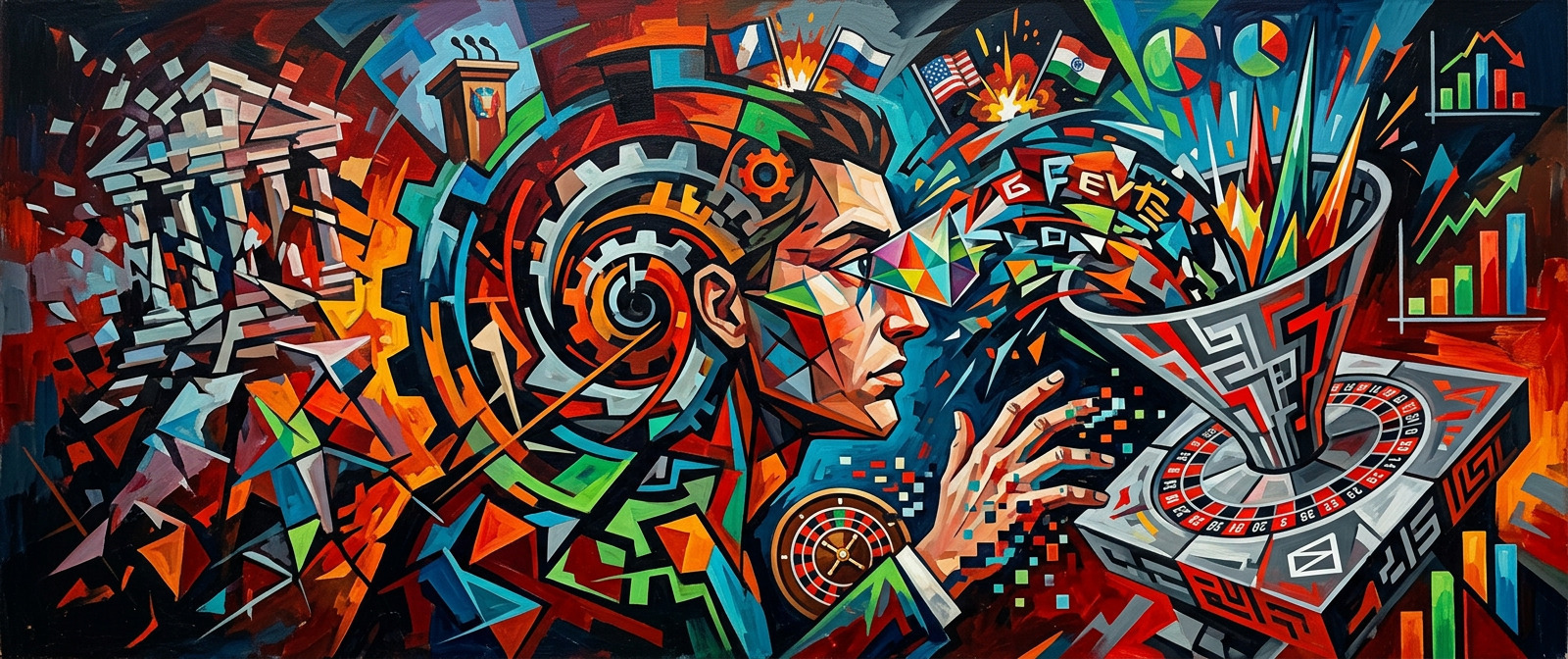



The crypto market used to sell a grand idea. It promised a new financial architecture, sovereign money, decentralization, digital ownership, and technologies that would rewrite the rules. But every prolonged crypto winter does the same thing to the market: it strips away ideology, burns out patience, and pushes capital to look not for fundamentals, but for motion.
When the long uptrend disappears, money flows to whatever can produce a fast outcome. Not to assets that may mature in three years, but to events that will resolve tomorrow, by evening, or in fifteen minutes. That is exactly the environment in which Polymarket found its momentum.
Formally, Polymarket is a prediction market where participants buy and sell probabilities tied to future events. In practice, it has become an ideal product for an age driven by nerves, headlines, and global instability. It sits in a gray zone between financial instrument, news terminal, and legalized betting. The platform itself describes Polymarket as the world’s largest prediction market, while its infrastructure already includes limit orders, liquidity programs, and maker rebates that make it feel much closer to a trading venue than a novelty app.
That is why Polymarket matters not just as a platform, but as a symptom. It is one of the clearest indicators of what part of the crypto economy becomes during periods of fatigue, uncertainty, and political turbulence.
Not a market for assets, but a market for outcomes
Traditional investing requires time. An investor chooses an asset, studies its model, trusts a team, survives volatility, and waits for the thesis to play out. In a bear market, that process becomes much harder. Time horizons shrink. People no longer want to wait through several cycles. They want a fast narrative.
Polymarket offers exactly that. It does not trade stocks, bonds, or even tokens in the usual sense. It trades outcomes. Will a candidate win. Will a regulator approve something. Will a politician say a specific phrase. Will Bitcoin rise over the next hour. Will a geopolitical event happen. The world stops being something to analyze and becomes a feed of triggers to position around.
That is a major cultural shift. Not long ago, crypto was obsessed with memecoins, absurd tokens, and viral narratives. Now the same impulse has put on a suit. Instead of a dog or a frog, the market now speculates on elections, sanctions, central bank decisions, wars, and breaking headlines. In form, the market looks more mature. In substance, it is still monetizing collective excitement.
Why Polymarket fits this era so well
Polymarket did not rise despite chaos. It rose because of chaos. The more uncertainty the world produces, the better markets perform when they can convert that uncertainty into a price.
Political crises, wars, rumors of negotiations, unexpected central bank remarks, leaks, elections, sanctions, violent crypto moves, even individual words in a public speech, all of it becomes tradable material. In such a system, news stops being just news. It becomes an asset.
That is one of the defining paradoxes of this era. The worse the global environment becomes, the more room there is for speculative activity. Not because markets love destruction, but because they love shifting probabilities. For Polymarket, instability is not a malfunction. It is the raw material.
That is also why prediction markets are now at the center of a serious regulatory debate. Regulators, exchanges, and market participants are trying to determine what these platforms really are: tools for measuring expectations, a new segment of derivatives, or a form of gambling dressed up as analytics. In March 2026, the CFTC launched a new rulemaking process on prediction markets, while major exchange executives openly argued that the sector needs clearer boundaries and stronger oversight.
The illusion of rationality
The most dangerous thing about Polymarket is not that it resembles a casino. The more interesting danger is that it lets users feel intellectually superior to a casino.
Everything looks respectable. There are probabilities, limit orders, order books, statistics, historical data, spreadsheets, models, bots, risk management logic, early exits, arbitrage, and hedging. The participant feels less like a gambler and more like an analyst. Less like someone placing a bet, and more like someone exploiting an informational edge.
That is where the critical line appears. Tables, formulas, and probability models do not magically turn a wager into an investment. A futures terminal does not automatically make every user a disciplined capital allocator.
If the core of the strategy is to recognize a headline faster than everyone else, jump into the move, trade the shift in probability, and exit before the final resolution, then this is not long-term investing. It is speculation on nerves. It is not capital formation. It is trading the headline.
From collective intelligence to suspicion of insider edge
Supporters of prediction markets often argue that such platforms outperform polls, television pundits, and conventional experts because they aggregate dispersed knowledge into a single market price. In theory, that sounds compelling. It also aligns with Robin Hanson’s broader idea of futarchy, where markets help guide decision-making by forcing people to put money behind beliefs instead of merely declaring opinions.
But in the real world, that model has a weakness. The more a market depends on information speed, the more it invites a dangerous question: who knows more than everyone else, and where did that knowledge come from?
In recent months, prediction markets have faced growing concerns about suspiciously well-timed trades around geopolitical events and leadership changes. Reuters reported that fears over insider-style informational advantages could damage trust in prediction markets as fair mechanisms for aggregating expectations. Once a market starts to look less like collective intelligence and more like a venue for those sitting closer to nonpublic information, the philosophy behind it changes immediately.
At that point, it is no longer the wisdom of crowds. It becomes an expensive game played against latecomers.
Politics as the new memecoin
The deeper cultural point is this: Polymarket has not merely created a new market. It has turned politics, geopolitics, and macroeconomics into a new class of speculative content.
Crypto used to gamble on meaningless tokens. Now it gambles on the probabilities of historic events. The difference appears dramatic, but in practice it is smaller than it looks. The object of speculation has simply become more respectable.
A memecoin was honest about its absurdity. A prediction market speaks the language of data, collective intelligence, and price discovery. Yet the user psychology is often the same. Find the mispricing. Buy cheaply. Get there before the crowd. Exit before resolution. Harvest dopamine from being right and from seeing price move.
That is why Polymarket fits the moment so perfectly. It embeds gambling inside the language of analysis. It allows speculation to sound like research, and betting to feel like intellectual work.
Where the real utility begins and ends
It would be lazy to say these markets are useless. Prediction markets can provide genuine value. They offer a fast snapshot of expectations, reveal consensus in real time, sometimes outperform media commentary, and can serve as an additional signal in political, economic, or journalistic analysis.
Polymarket itself also no longer looks like an improvised crypto toy. Users cannot directly create markets, but they can suggest them, while the platform continues to formalize rules, dispute resolution, liquidity programs, and new short-duration crypto market formats with fees and rebates.
But a useful tool can still be used in a deeply speculative way. In mass behavior, Polymarket is less an academic truth machine and more a fast market interface for trading expectations. That is what keeps it closer to a casino than many of its defenders would like to admit.
Conclusion
Polymarket matters not because it is just another successful crypto product. It matters because it captures the present state of the market with unusual precision.
When confidence in long technological narratives weakens, capital starts trading short narratives.
When investing becomes boring and frightening, betting becomes tempting.
When the world becomes too unstable for strategic patience, platforms that can package fear, rumor, news, and political crisis into liquid contracts become inevitable.
That is why Polymarket is more than a prediction market. It is a showcase of crypto’s new psychology. Here, investing gives way to reflex, analysis fuses with азарт, and politics becomes the new memecoin for people who no longer want to understand the world, but to outtrade it over short time frames.
And that may be the clearest conclusion of all. Crypto still speaks the language of the future. But more and more often, it earns money from whatever is happening right now, while the world argues, burns, votes, and panics.

Top comments (0)