
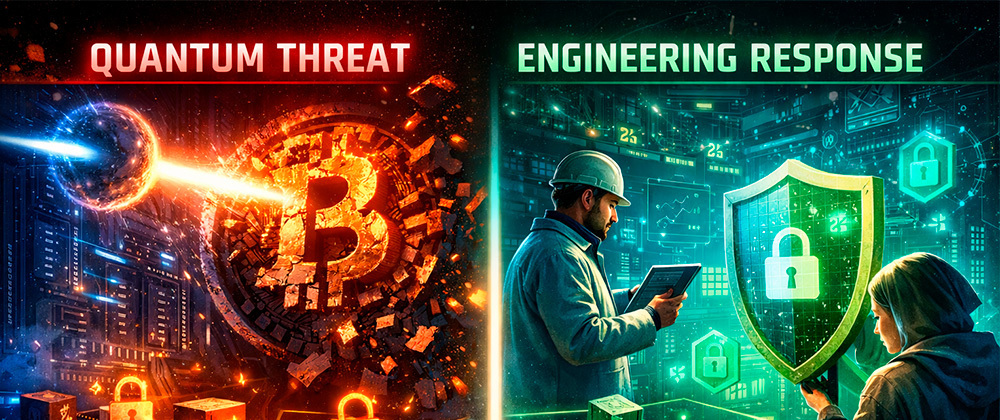

What Q-Day is, why Bitcoin and Ethereum are vulnerable to quantum computers, and which strategies the market is already preparing for a post-quantum blockchain future.
Shadows of Q-Day: the battle for the future of blockchain
Awareness. Q-Day as a point of no return
Q-Day is a conditional term for the moment when quantum computers reach sufficient power to practically break classical cryptographic algorithms. The primary target is elliptic curve cryptography (ECC), which underpins Bitcoin, Ethereum, and the vast majority of modern blockchains.
It is important to understand: Q-Day is not an overnight “internet apocalypse.” It is an asymmetric event where a new class of attacks emerges, one that existing networks are structurally unprepared for. Once scalable implementations of Shor’s algorithm become feasible, private keys can be derived directly from public keys.
According to estimates by Project Eleven, hundreds of billions of dollars in BTC are already at risk due to public keys that have been revealed on-chain through normal transaction activity. A separate category includes lost wallets, which cannot migrate or upgrade cryptography and therefore become prime targets for future attacks.
Comprehension. Why the problem runs deeper than it seems
Bitcoin and Ethereum are not “bad systems.” They are victims of their own success and of the era in which they were designed. At the time of their creation, quantum computing existed largely as a theoretical concept.
The key structural limitations of legacy blockchains include:
- reliance on ECC and ECDSA;
- inability to replace cryptography at scale without social consensus;
- massive economic inertia across trillion-dollar ecosystems;
- exposed public keys that cannot be revoked.
This leads to a fundamental question: what do you do with a network that cannot be safely or quickly upgraded, yet secures trillions of dollars in value?
The market has already produced two fundamentally different answers.
Conviction. Two paths that cannot be merged
Path one: post-quantum migration of legacy networks
This approach is chosen by those whose priority is preserving existing capital and infrastructure.
A key player here is Project Eleven, which develops tooling for gradual post-quantum migration of Bitcoin and other networks without immediate hard forks.
The core idea:
- post-quantum keys are generated in advance;
- they are linked to existing addresses off-chain;
- public keys are not revealed until protocol upgrades occur;
- migration can be executed via soft forks.
The Yellowpages.xyz tool is primarily aimed at institutional holders and infrastructure providers. Project Eleven also collaborates with the Solana Foundation, where full threat assessments and quantum-resistant transaction testnets have already been conducted.
Strengths of this approach:
- minimal social and economic disruption;
- preservation of existing network effects;
- controlled, gradual transition.
Limitations:
- lost or already exposed keys remain vulnerable;
- any Bitcoin changes require years of discussion and coordination.
Path two: architectures designed for Q-Day from the ground up
The second approach starts from a different premise: if the foundation is outdated, it should not be patched — it should be rebuilt.
A representative example is Cellframe Network, a Layer-0 protocol designed from inception with post-quantum threats in mind.
Key architectural decisions behind Cellframe:
- use of Falcon and CRYSTALS-Dilithium;
- multi-algorithm signatures for cryptographic redundancy;
- dual-layer sharding to compensate for “heavy” PQ signatures;
- rejection of classic smart contracts in favor of conditional transactions;
- focus on infrastructure and non-financial use cases.
Between 2025 and 2026, the ecosystem delivered:
- CF-20 as a post-quantum token standard;
- Shared Funds for DAOs;
- an upgraded wallet with a built-in DEX;
- preparation for a full mainnet with native smart contracts.
The strength of this approach lies in architectural purity and long-term scalability. Its limitation is the need for bridges to legacy ecosystems and the absence of immediate network effects comparable to Bitcoin.
Conviction. Why both sides are right
Attempting to declare a single “correct” strategy is a methodological mistake.
- For BTC holders, institutions, and core infrastructure, the Project Eleven approach is rational.
- For new applications, services, and protocols, networks that are post-quantum by design, such as Cellframe, are the logical choice.
The Y2K precedent showed that threats which appear theoretical for years often become practical abruptly. The difference is that Q-Day cannot be solved with a simple patch.
Action. What Q-Day means for the market in 2026
2026 is not a year for panic. It is a year for preparation.
Rational steps include:
- conducting cryptographic readiness assessments;
- beginning key and infrastructure migration;
- choosing protocols with post-quantum architectures;
- avoiding complacency toward risks that still feel distant.
The future of blockchain will be determined not by short-term hype cycles, but by the durability of its engineering decisions. Q-Day is not a question of “if,” but of who will be ready.




Top comments (0)