
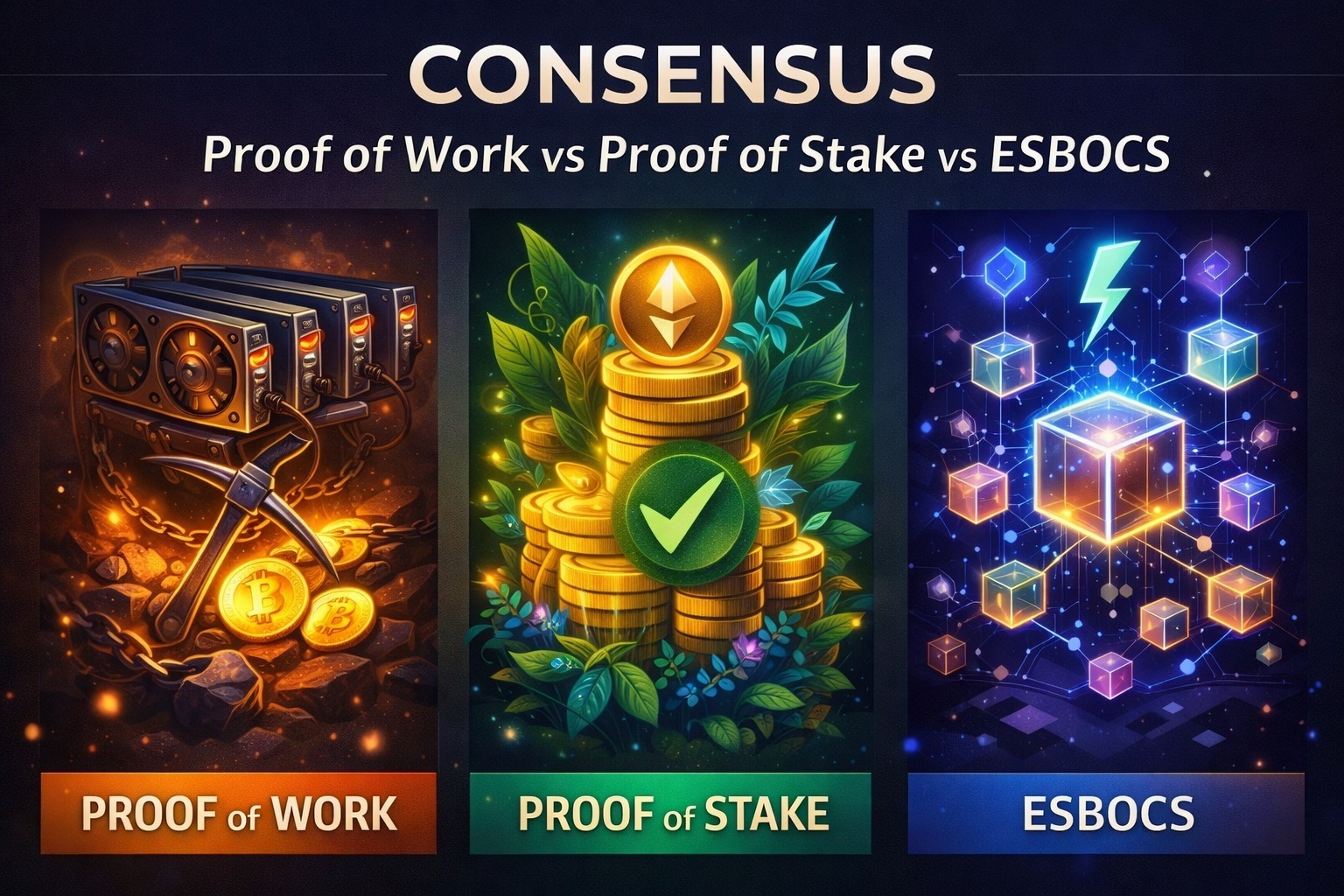

Hey. If blockchain is a distributed database, then consensus is the rule everyone follows to agree on which version of events is correct. Imagine a group of friends keeping a shared list of debts. If one says "you owe me" and another says "no I don't," you need a way to settle it. In blockchain, math settles it.
Let's break down three approaches: classic PoW (Bitcoin), modern PoS (Ethereum post-Merge), and ESBOCS — the one people ask about with Cellframe.
⛏️ Proof of Work (PoW) — "Proof of Work"
How It Actually Works
Miners collect transactions from the mempool (the queue of unconfirmed transfers) and assemble their own block candidates. Then the race begins: they need to find a special number — a nonce — to stick in the block header so that the block's hash comes out below a specific target value (starts with a bunch of zeros) .
This is pure brute force: billions of attempts per second. Whoever finds the right nonce first broadcasts their block to everyone else. Others quickly verify: if the hash checks out, the block is accepted, the miner gets the reward (new coins + fees), and everyone starts hunting for the next block .
Why It's Secure
To rewrite history, you'd have to redo all that work — which means controlling more than 50% of the network's computing power. For Bitcoin, that's hundreds of millions of dollars in hardware and electricity. Economically, it just doesn't make sense .
Downsides
- Energy consumption. Bitcoin eats electricity like a small country .
- Speed. A Bitcoin block takes ~10 minutes to find, and you usually wait for several more blocks to be sure .
- Mining centralization. Giant farms and pools dominate; a regular person with a GPU doesn't stand a chance .
🥩 Proof of Stake (PoS) — "Proof of Stake"
How It Works
Instead of miners, you have validators. To become a validator, you need to lock up (stake) a certain amount of coins as collateral. In Ethereum, for example, it's 32 ETH .
Here's the step-by-step:
- All validators watch the transaction flow.
- The algorithm randomly selects one validator to propose the next block. Bigger stake means higher odds, but it's not an auction — randomness is baked in .
- The lucky one gathers transactions, builds a block, and signs it.
- The block goes out for verification to other validators (or a committee). They check every transaction and vote — this is called attestation .
- If the block gets more than 2/3 of the votes, it's accepted and added to the chain .
- Honest validators get rewarded. If someone cheats (signs two conflicting blocks or goes offline), their stake gets partially burned — that's slashing .
Why It's Secure
To attack the network, you'd need to control 51% of all staked coins. Buying that many coins would pump the price, and a successful attack would crash it — you'd lose your own money. Economically pointless .
Pros
- Energy efficient. After Ethereum switched to PoS, energy consumption dropped by ~99.95% .
- Low entry barrier. No expensive hardware — a regular computer works .
- Flexibility. You can join staking pools, delegate your coins, etc. .
Cons
- Centralization risk. Big holders could gain too much influence. Some networks (like Ethereum) fight this with randomization and caps .
- Operational risks. Node misconfiguration, internet issues — and you might get slashed .
🧬 ESBOCS — Solid-State Proof of Stake (Cellframe's Take)
Now for the interesting part. ESBOCS is a PoS modification built for Cellframe. If regular PoS is a general blueprint, ESBOCS is tuned for specific jobs.
What Makes It Different?
1. Lightweight Blocks
In classic PoS (Ethereum), every validator signs every block — tens of thousands of signatures. Blocks get fat. In ESBOCS, a small random group (up to 10 validators) signs each block. That's enough for security, but blocks stay compact .
2. Post-Quantum Crypto
Regular signatures (ECDSA) won't survive quantum computers. ESBOCS uses post-quantum algorithms — CRYSTALS-Dilithium, both NIST-approved. This is protection for the next decade and beyond.
3. Dynamic Committees
Validators aren't fixed forever. The network constantly shuffles the signing group: each block, a random validator might join the committee, and the oldest one leaves. No one holds power too long .
4. Built for Sharding
ESBOCS was designed for two-layer sharding. Each service (L1) runs its own blockchain, and inside each, small groups sign blocks. This lets the whole system scale almost infinitely.
Why Bother?
Because you want a blockchain that's fast, secure, and quantum-resistant. Regular PoS isn't built for that — it either sacrifices speed for decentralization (like Ethereum) or uses heavy signatures. ESBOCS tries to take the best of both worlds.
📊 Side-by-Side
| Mechanism | Core Idea | Pros | Cons |
|---|---|---|---|
| PoW | Whoever invests more in hardware wins | Battle-tested security, neutral | Energy hog, slow, expensive gear |
| PoS | Whoever stakes more gets more weight (but randomness matters) | Energy efficient, fast, low entry | Centralization risk, validator ops risk |
| ESBOCS | Small groups sign blocks, post-quantum crypto | Very fast blocks, scales well, future-proof | Newer tech, less battle-tested |
🤔 So Which One Should You Use?
Building digital gold where security is everything? Stick with PoW (Bitcoin). Need a fast, green network for millions of users? Go PoS (Ethereum). Looking for scalability and quantum resistance for the next 20 years? Take a hard look at ESBOCS and platforms like Cellframe.
By 2026, consensus isn't a religion anymore. Each mechanism solves a specific problem. The trick is understanding how they actually work under the hood.
Got questions about implementations? Ask away — I'll tell you straight.



Top comments (0)