

Hey, friend. Ever stood in line at one teller while five windows sat empty? That's how blockchains without sharding work. By 2026, this tech finally grew up from exotic buzzword to working tool. Let's break down what's real, what's not, and where sharding actually delivers.
What Even Is Sharding?
Imagine a massive library with thousands of visitors daily. If there's only one reading room, chaos. Sharding means you split that library into specialized rooms: detective novels here, sci-fi there, textbooks in the corner. Visitors spread out, everyone's comfortable.
In database (and blockchain) speak, this is horizontal scaling. Instead of making one server stronger (vertical scaling), you just add more servers and spread data across them .
Technically, you need a sharding key — user ID, region, whatever. The system looks at that key and instantly knows which shard (data chunk) handles your transaction .
Database Sharding Example (So You Really Get It)
Say you've got a customer database. You decide to shard by last name first letter:
- Shard 1: A-I
- Shard 2: J-R
- Shard 3: S-Z
When someone queries "Petrov", the system heads straight to shard 3 instead of scanning the whole mess . Enterprise databases (Oracle, etc.) have done this for years — they can even shard by fields inside JSON documents .
Why Bitcoin Never Needed Sharding (And Never Will)
Bitcoin's the conservative grandpa of crypto. No sharding, likely never. Why? Because Bitcoin was designed as maximally simple and secure. Every miner stores the full copy of the entire blockchain and verifies every single transaction .
It's like every library visitor carrying copies of every book. Secure? Yes. Scalable? No. Bitcoin does ~7 transactions per second — a conscious trade-off for security and decentralization. Works fine for digital gold, terrible for mass payments.
Sharding in Mainstream Blockchains: Ethereum & Co.
Here's where things got interesting. Ethereum originally planned sharding as core to its roadmap, then... changed course .
Ethereum: Data Sharding, Not Execution Sharding
Current Ethereum uses sharding for data availability, not transaction execution . Think of it as libraries storing only catalogs in each room, with actual books in specialized storage (L2 solutions). In practice: Ethereum became the settlement layer, while L2 rollups do the heavy lifting and batch-post data back .
Vitalik recently admitted the original vision — L2s as "branded sharding" of Ethereum — isn't working . Many L2s remain too centralized (still using multisig bridges instead of proper crypto security), and trust levels are lower than hoped .
NEAR Protocol and Nightshade
NEAR did sharding differently. Their Nightshade tech lets each shard process its own transactions, while validators check everything without storing full data for each shard. In Q2 2026, they're rolling out state sharding — splitting not just new transactions but the entire network state into pieces . Promises 100,000+ TPS. Sounds great — let's see delivery.
Cellframe: Where Sharding Actually Gets Interesting
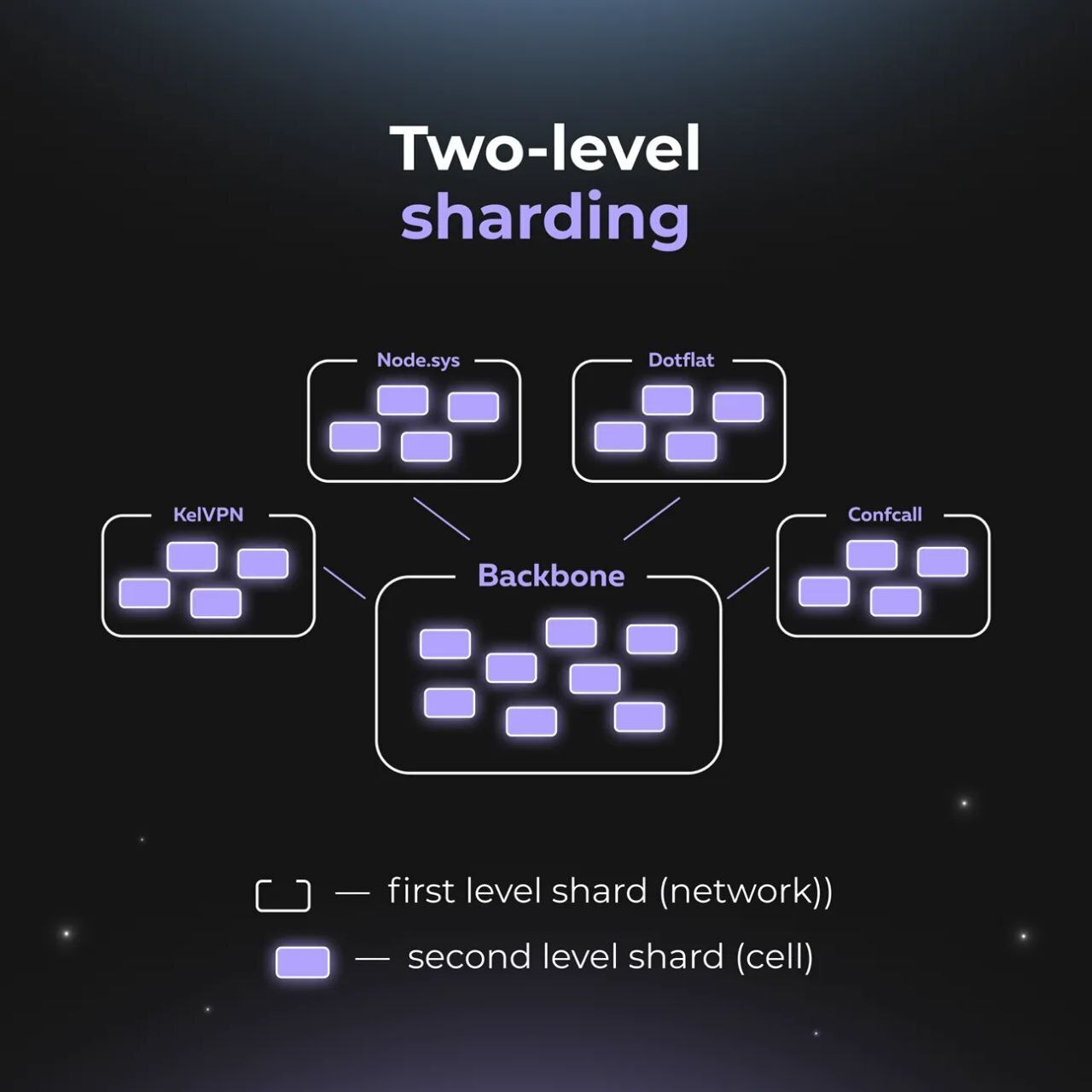
This is where sharding stops being theory. Cellframe built two-layer sharding, and it's not just marketing.
Layer 1 (L1 within L0) — separate blockchains for each service. KelVPN (decentralized VPN) lives in its own chain, Backbone (token exchange) in another, plus dozens more projects. They run in parallel, never interfering. Like opening separate stores in a mall instead of one giant tent.
Layer 2 — dynamic Cells. When one blockchain (say, KelVPN) gets slammed, it doesn't slow down — it splits into smaller chains called Cells. Each Cell processes its own transaction batch . If a Cell overloads, it automatically forks into two new ones. Like opening another checkout counter every time the line grows — infinitely.
The key insight: No single chain storing everything. Multiple parallel chains, each doing its own thing. That's real horizontal sharding — what everyone talks about, Cellframe actually built.
The Numbers and Trends
By 2026, the market finally gets it: sharding isn't hype, it's necessity. Gemini analysts predict Ethereum 2.0 sharding reaching final implementation stages . Asset tokenization (real estate, stocks, everything) will demand transaction volumes that make sharding non-negotiable .



Top comments (0)