
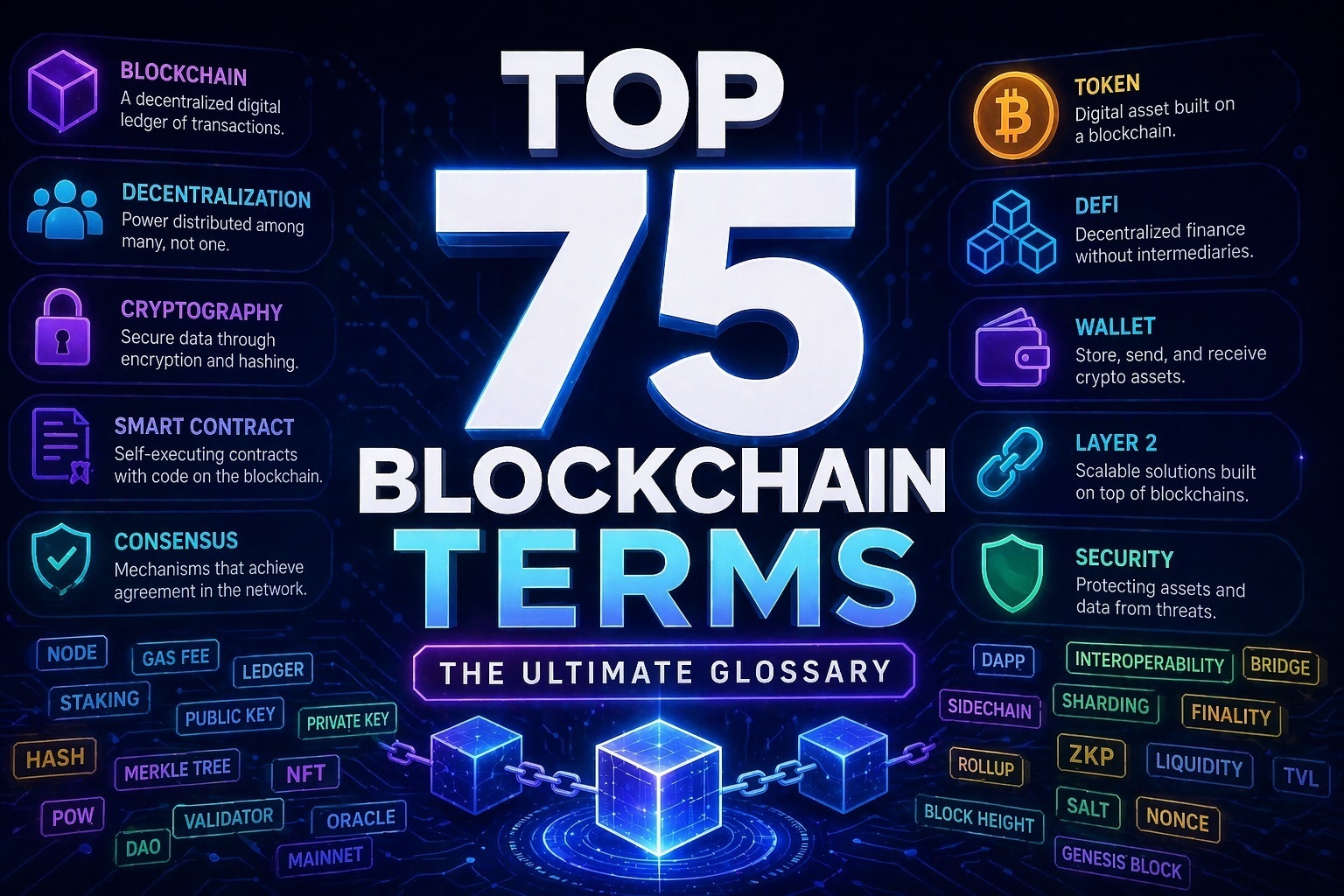

Blockchain is a fast‑evolving field with its own language. This glossary helps you quickly navigate terms from “Shor’s algorithm” to “zk‑rollup”. It includes the most important concepts of 2026 – from classics (Bitcoin, node, smart contract) to the latest (post‑quantum cryptography, agentic economy, DePIN, L0). Each term has a short, no‑fluff definition.
Basic Terms
Blockchain – A distributed database made of a chain of blocks. Each block contains a list of transactions and is cryptographically linked to the previous one, ensuring immutability and transparency.
Block – A structural unit of a blockchain that holds a list of transactions, a timestamp, the hash of the previous block, and other metadata.
Transaction – An operation that transfers digital assets (coins, tokens) from one address to another, signed by the sender’s private key.
Node – A computer running blockchain software. It stores a copy of the ledger (or part of it), verifies transactions, and relays data.
Full node – Stores the entire blockchain and independently verifies every transaction without trusting others.
Light node (SPV) – Stores only block headers and requests transaction details from full nodes. Runs on smartphones.
Address – A cryptographic identifier to which cryptocurrency can be sent. Derived from a public key.
Private key – A secret code that gives access to funds at an address. Never share it. “Not your keys, not your coins.”
Public key – An open identifier used to verify signatures and receive funds (after hashing it becomes an address).
Hash – The output of a cryptographic function that turns input data into a fixed‑length string. Even a tiny change in input completely changes the hash.
Mining – The process of creating new blocks in Proof‑of‑Work networks (e.g., Bitcoin) by solving cryptographic puzzles that require computational power.
Validator – A participant in a Proof‑of‑Stake network who stakes coins, checks transactions, and signs blocks, earning rewards.
Staking – Locking coins in a network to participate in consensus and earn income. An alternative to mining.
Gas – A unit measuring the computational work required to execute a transaction or smart contract in Ethereum‑compatible networks. Fees are paid in the native coin (ETH, BNB).
Mempool – A pool of unconfirmed transactions waiting to be included in a block.
Consensus & Governance
Consensus – The mechanism that allows all blockchain nodes to agree on the state of the ledger without a central coordinator.
Proof‑of‑Work (PoW) – A consensus that requires computational work to create a block. Miners solve a cryptographic puzzle; the first to find the solution gets the reward.
Proof‑of‑Stake (PoS) – A consensus where the right to create a block is randomly chosen among validators in proportion to their stake. Energy‑efficient.
Delegated Proof‑of‑Stake (DPoS) – Token holders vote for a limited number of delegates who maintain the network on their behalf.
Proof‑of‑Authority (PoA) – Trusted nodes (authorities) validate transactions. Used in private and consortium blockchains.
Byzantine Fault Tolerance (BFT) – The ability of a system to continue working correctly even if up to one‑third of nodes behave maliciously or fail.
Fork – A divergence of the blockchain into two versions. Can be soft (compatible with old rules) or hard (incompatible, requires all nodes to upgrade).
Sybil attack – An attacker creates many fake nodes to gain disproportionate influence over the network.
51% attack – An attacker controls more than half of the network’s hashrate (PoW) or stake (PoS) and can rewrite transaction history.
Slashing – A penalty in PoS: part of a validator’s stake is burned for rule violations (double signing, prolonged inactivity).
Cryptography
ECDSA (Elliptic Curve Digital Signature Algorithm) – A digital signature algorithm based on elliptic curves. Used in Bitcoin and Ethereum, but vulnerable to quantum computers (Shor’s algorithm).
Shor’s algorithm – A quantum algorithm that can factor large numbers and solve discrete logarithms in minutes, breaking ECDSA and RSA.
Post‑Quantum Cryptography (PQC) – Algorithms resistant to quantum computer attacks. They run on classical hardware.
CRYSTALS‑Dilithium (ML‑DSA) – NIST standard (FIPS 204) for lattice‑based post‑quantum digital signatures. Used in Cellframe.
Falcon (FN‑DSA) – A compact lattice‑based post‑quantum signature algorithm, expected NIST standard (FIPS 206). Also used in Cellframe.
Kyber (ML‑KEM) – NIST standard (FIPS 203) for post‑quantum key exchange. Used in Cellframe for channel encryption.
SPHINCS+ (SLH‑DSA) – Hash‑based post‑quantum signatures, a NIST backup standard (FIPS 205). Very secure but large signatures.
Lattice – A mathematical structure used in post‑quantum cryptography. Lattice problems (LWE, SVP) are believed hard even for quantum computers.
LWE (Learning With Errors) – A mathematical problem underlying many post‑quantum algorithms, including Dilithium and Kyber.
Q‑day – The hypothetical day when a sufficiently powerful quantum computer appears that can break modern cryptography. Estimates: 2029–2032.
Quantum entanglement – A phenomenon where the states of two qubits are interdependent regardless of distance. Used in quantum computers and quantum cryptography.
Superposition – The ability of a quantum system to exist in all possible states simultaneously. Gives quantum computers parallelism.
Qubit – The basic unit of quantum information (quantum bit). Can be 0, 1, or both at once.
Harvest now, decrypt later – A strategy of collecting encrypted data (e.g., public keys from the blockchain) now to decrypt them later when a quantum computer becomes available.
Scaling & Architecture
Sharding – A horizontal scaling method where the blockchain is split into parallel segments (shards), each processing its own portion of transactions.
Two‑layer sharding – Cellframe’s architecture: first layer – independent L1 blockchains for different services; second layer – dynamic Cells inside each L1 for parallel transaction processing.
L0 (Layer 0) – Foundational infrastructure that connects different blockchains and enables cross‑chain communication. Examples: Polkadot, Cosmos, Cellframe.
L1 (Layer 1) – A base blockchain (Bitcoin, Ethereum, or Cellframe’s L1 parachains) responsible for consensus and final settlement.
L2 (Layer 2) – Overlays on top of L1 for scaling: rollups, payment channels, sidechains. Examples: Lightning Network, Arbitrum, Optimism.
Rollup – An L2 technology that executes transactions off‑chain and then posts compressed data (proofs) to L1. Optimistic and zk‑rollups exist.
zk‑Rollup – A rollup that uses zero‑knowledge proofs to verify batches of transactions. Offers high throughput and privacy.
Payment channel – A two‑way channel for an unlimited number of transactions between two parties, with final settlement on the blockchain (Lightning Network).
Sidechain – An independent blockchain connected to the main chain via a two‑way bridge. Allows experimentation without risking the mainnet.
Bridge – A protocol for transferring assets and data between different blockchains. Can be trusted or trustless.
DeFi, NFTs & Tokens
DeFi (Decentralized Finance) – Decentralised finance: applications for lending, trading, saving without intermediaries, based on smart contracts.
DEX (Decentralized Exchange) – A decentralised exchange where users trade directly from their wallets, without a custodian (Uniswap, Curve).
AMM (Automated Market Maker) – A mathematical formula for pricing tokens in liquidity pools without a traditional order book.
Liquidity pool – A smart contract where users lock token pairs to provide trading liquidity on a DEX and earn fees.
Yield farming – A strategy of moving assets between different DeFi protocols to maximise returns.
Stablecoin – A cryptocurrency whose price is pegged to a fiat currency (usually USD) or backed by other assets. Examples: USDT, USDC, DAI.
NFT (Non‑Fungible Token) – A unique token with a unique identifier. Proves ownership of a digital or physical item.
Token – A digital unit created on top of an existing blockchain (unlike a coin, which has its own blockchain). Can be fungible (ERC‑20) or non‑fungible (ERC‑721).
Governance token – A token that gives its holder voting rights in a DAO or protocol (UNI, AAVE, MKR).
Utility token – A token that grants access to a platform’s services or functions (e.g., fee payment, staking).
ERC‑20 – The standard for fungible tokens on Ethereum.
CF‑20 – The standard for post‑quantum fungible tokens on Cellframe.
Atomic swap – A trustless, direct exchange of assets between different blockchains without intermediaries (e.g., BTC for LTC).
Security & Wallets
Hardware wallet – A physical device that stores private keys in an isolated environment (Ledger, Trezor). The most secure storage method.
Custodial wallet – Funds are held by an exchange or provider; the user does not control the private keys. Convenient for trading, risky for long‑term storage.
Non‑custodial wallet – The user fully controls private keys and funds. Examples: MetaMask, Cellframe Wallet.
Multisig (multi‑signature) – A transaction requires the approval of several keys (e.g., 2 of 3). Enhances security for treasuries and DAOs.
Whitelist address – A list of addresses allowed for withdrawal. Protects against hacking and phishing.
Phishing – A type of attack where attackers impersonate official services to steal seed phrases and private keys.
Seed phrase – A set of 12–24 words that can recover all private keys of a wallet. Store only on paper or metal, never digitally.
Advanced & New Concepts (2026)
DAO (Decentralized Autonomous Organization) – An organisation governed by smart contracts and token‑holder voting, without hierarchy or central leadership.
DePIN (Decentralized Physical Infrastructure Networks) – Decentralised physical infrastructure networks: users provide equipment (Wi‑Fi hotspots, sensors, cameras) and earn tokens. Examples: Helium, Hivemapper.
AI agent – An autonomous program that has a crypto wallet and can independently make transactions, exchange data, and pay for services with other AIs.
Agentic economy – An economic system where AI agents are full‑fledged market participants, paying each other for resources and services.
RWA (Real World Assets) – Tokenised real‑world assets: real estate, stocks, bonds, artworks, brought onto the blockchain.
Conditional transaction – A transaction whose output can only be spent when a predetermined condition is met. In Cellframe, it replaces smart contracts – no code, no reentrancy vulnerabilities.
How to Use This Glossary
- When you encounter an unfamiliar term in an article or news, quickly look it up here.
- Definitions are concise – just the essence.
- The glossary will be updated as new technologies and standards emerge.
Tip: Bookmark this page. In the fast‑moving blockchain world, having terminology at your fingertips is always useful.



Top comments (0)