
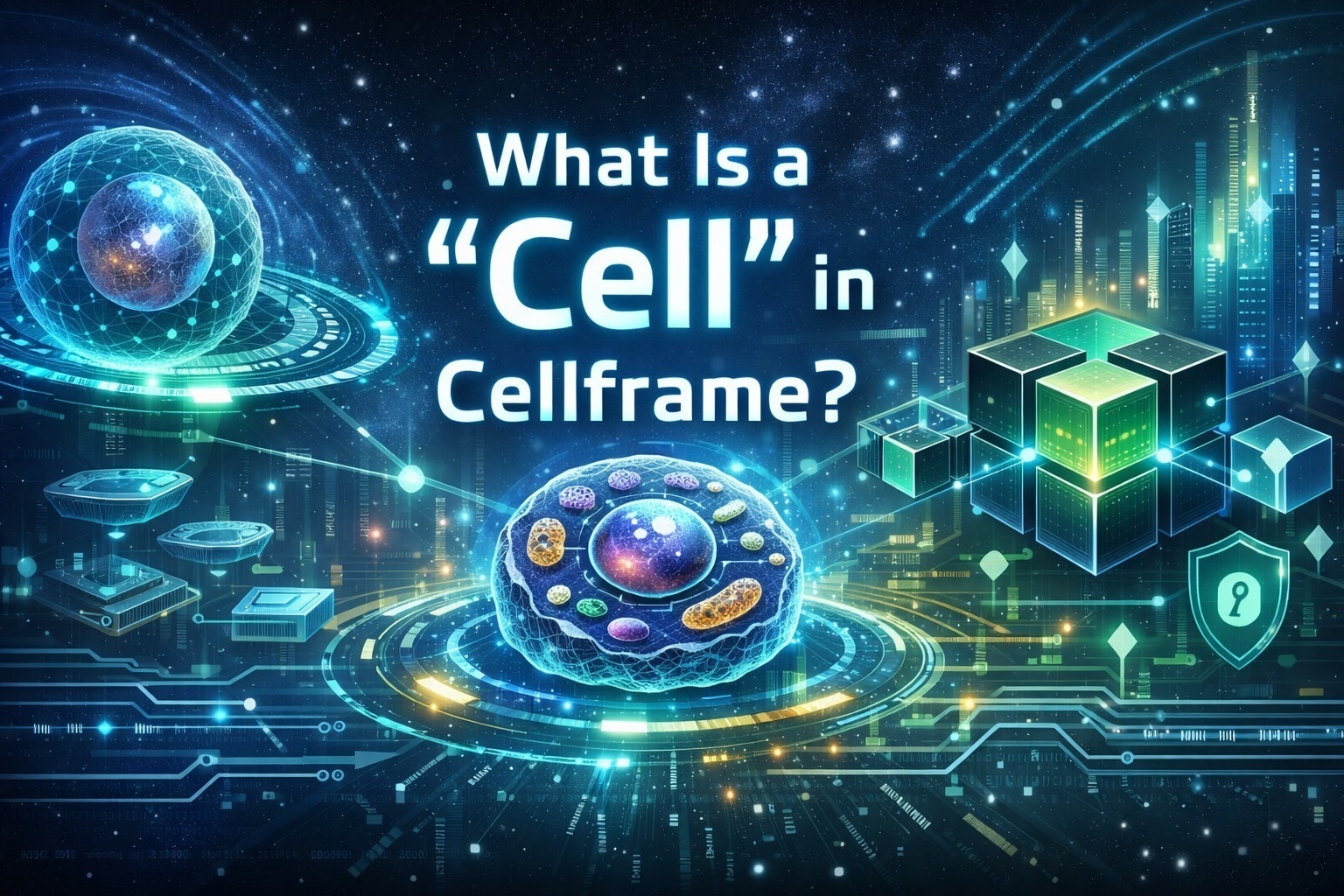

Cell (also called a "Cellchain" or "shardchain") is the smallest scalable unit of the Cellframe network – a lightweight, independent blockchain that can be dynamically created and split to handle parallel transaction processing. Cells form the second layer of Cellframe’s two‑layer sharding: first, separate L1 blockchains (like KelVPN or Backbone) operate independently on the L0 mainnet. When one of these L1 chains gets overloaded, it automatically divides into multiple Cells, each processing its own portion of transactions in parallel. If a single Cell becomes overloaded, it can further fork into new Cells – creating virtually infinite horizontal scalability.
Where Does the "Cell" Fit in Cellframe’s Architecture?
Cellframe’s architecture consists of three layers. Cells belong to the second level of the platform’s unique two‑layer sharding design.
| Layer | Description | Role of Cells |
|---|---|---|
| L0 (Mainnet) | The quantum‑resistant foundation – handles consensus, post‑quantum cryptography (Falcon, Dilithium), and network governance | Provides security and identity for all Cells |
| L1 (Parachains) | Independent service‑specific blockchains (KelVPN, Backbone, etc.) running on L0 | Each L1 chain can spawn multiple Cells |
| Cells (Layer 2 Sharding) | Lightweight parallel chains inside an L1 blockchain | This is the Cell – the actual unit that processes transactions in parallel |
The key innovation is that Cells are dynamic. Unlike static shards in other blockchains, Cells in Cellframe are born, split, and can even be archived as needed.
How Does a Cell Work?
Think of a Cell as a mini‑blockchain that processes only a fraction of the total transactions. When traffic grows, the system automatically creates more Cells to share the load.
The Anatomy of a Cell
- Each Cell has its own Base Chain – a mini‑ledger similar to Cellframe’s ZeroChain, but dedicated to that specific Cell’s transactions.
- Cells are "syngeneic" – the white paper compares them to stem cells that can convert into any specialised cell type. Each Cell can have its own attributes, own token, and even its own type of consensus.
- Cells communicate peer‑to‑peer – administrative information about Cells, tokens, and ledger locations is stored on ZeroChain, but inter‑Cell communications are direct.
- Cells are always connected to ZeroChain – the main L0 chain, which provides finality and security.
Transaction Flow Through Cells
When a user sends a transaction on a Cellframe L1 blockchain (e.g., KelVPN):
- The transaction enters the mempool of the appropriate L1 chain.
- The L1 chain’s sharding algorithm determines which Cell should handle the transaction (based on a sharding key – e.g., sender address, service type).
- The assigned Cell processes the transaction independently, in parallel with other Cells.
- Periodically, the Cell submits a summary (checkpoint) to ZeroChain for finality and security.
Because each Cell processes its own batch of transactions simultaneously, the total throughput scales with the number of active Cells.
What Is Shard‑Forking? (The Magic Behind Infinite Scalability)
Shard‑forking is the automatic process that splits an overloaded Cell into two independent Cells – the core mechanism that makes Cellframe’s scalability virtually infinite.
Here’s how it works:
| Step | What happens |
|---|---|
| 1. Load monitoring | The network continuously tracks the transaction load on each Cell. |
| 2. Threshold reached | When a Cell’s load exceeds a predefined limit, the system triggers a fork. |
| 3. Fork execution | The overloaded Cell splits into two new, fully independent Cells. |
| 4. Archiving | The original Cell is archived (its history is preserved for archival nodes). |
| 5. Parallel operation | The two new Cells start processing transactions in parallel, distributing the load. |
"If the load on a specific Cell increases to such a limit that it interferes with efficient functioning, the owner of the Cell can create any number of Cells in support of the first one." — Cellframe White Paper
As of mid‑2025, the shard‑forking mechanism was already implemented and ready, with developers finalising testing and bug fixes. The first fork was planned to happen with the zero shard on the Backbone chain. The second‑level sharding (which fully activates this feature across the entire network) is scheduled for Cellframe Node 6.1.
What Makes Cells Different from Regular Shards?
Unlike traditional blockchain sharding (e.g., Ethereum’s planned data sharding), Cells in Cellframe are not static – they are dynamic, recursive, and can be created instantly without hard forks.
| Feature | Traditional Sharding | Cellframe Cells |
|---|---|---|
| Number of shards | Fixed at launch | Dynamic – can increase or decrease |
| Shard creation | Requires protocol upgrade or hard fork | Automatic via shard‑forking, no hard fork needed |
| Shard granularity | Coarse (e.g., 64 shards total) | Fine‑grained – can scale to thousands of Cells |
| Load adaptation | Manual or predefined | Automatic – Cells split when overloaded |
| Developer control | None – shards are system‑managed | Cell owners can create Cells on demand |
This design makes Cellframe’s sharding horizontal and elastic – the network doesn’t just have 64 shards; it can have as many as needed, and each can further split into more Cells as demand grows.
How Do Cells Relate to Master Nodes and Staking?
Running a master node (validator) is tied to a specific Cell – not the entire L1 blockchain. To become a validator, you need to stake 10,000 CELL, which gives you 10 mCELL tokens, granting you the right to operate a master node within a particular Cell.
| Staking requirement | Value |
|---|---|
| Minimum stake | 10,000 CELL |
| mCELL received | 10 mCELL (1 mCELL = 1,000 CELL) |
| Lock period | Duration of master node operation |
After the upcoming hard fork (scheduled for version 6.1), the resource requirements for master nodes will be significantly reduced, enabling faster network processing and quicker node synchronisation.
If you don’t want to run your own master node, you can delegate your mCELL tokens to an existing validator and receive a share of their earnings – without running any hardware yourself.
Glossary of Cell‑Related Terms
| Term | Definition |
|---|---|
| Cell | The smallest scalable unit of the Cellframe network – an independent blockchain that processes transactions in parallel. Also called a shardchain or Cellchain. |
| Cellchain | Another name for a Cell – a lightweight, mini‑blockchain within an L1 parachain. |
| Shard‑forking | The automatic process of splitting an overloaded Cell into two independent Cells to maintain performance. |
| Two‑layer sharding | Cellframe’s unique architecture: first layer – independent L1 blockchains; second layer – dynamic Cells inside each L1. |
| Syngeneic Cell | A metaphor from the white paper: Cells are like stem cells that can convert into any specialised type, each with its own rules, token, and consensus. |
| ZeroChain | The main L0 chain that stores administrative information about all Cells and provides finality. |
| Base Chain | Each Cell’s internal mini‑ledger, similar to ZeroChain but dedicated to that Cell’s transactions. |
| mCELL | A token received when staking 10,000 CELL; required to launch a master node within a Cell. |
Summary
A Cell is the building block of Cellframe’s scalability. It is a lightweight, independent blockchain that processes transactions in parallel with other Cells. When traffic grows, Cells automatically split through shard‑forking, creating virtually infinite horizontal scaling – no hard forks, no manual reconfiguration.
This dynamic, elastic sharding design is what allows Cellframe to handle heavy post‑quantum signatures (20–40× larger than ECDSA) without collapsing under the load. While traditional blockchains struggle with static shards or L2 workarounds, Cellframe’s Cells adapt in real time to demand.
And when Q‑day arrives, this architecture will become not just an advantage, but a necessity.


Top comments (0)