
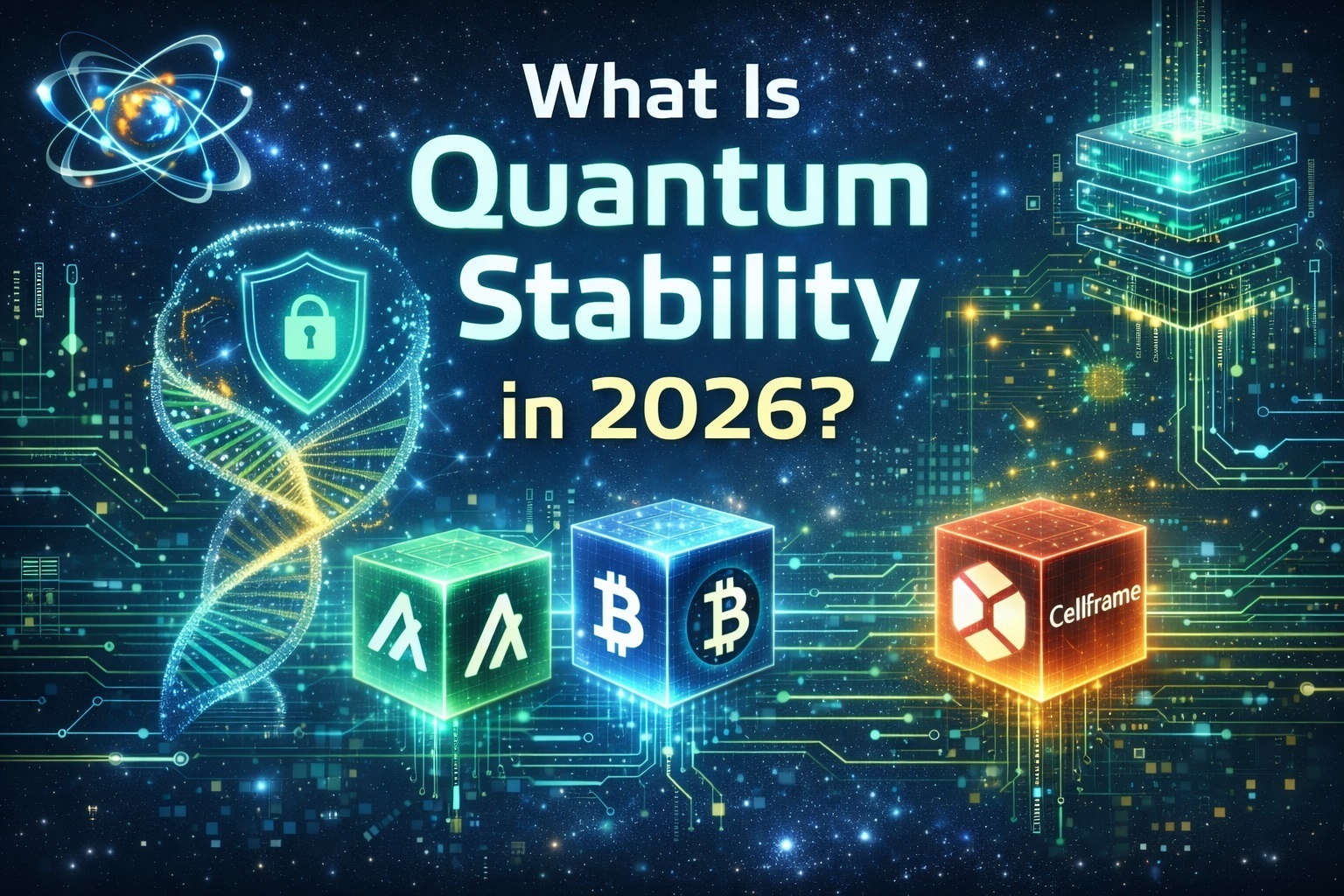

Quantum stability is a blockchain’s ability to maintain secure, continuous operation after a cryptographically relevant quantum computer (CRQC) appears. It combines two layers: quantum resistance (the use of post‑quantum cryptography (PQC) to prevent key extraction) and quantum resilience (the architectural capacity to upgrade algorithms without hard forks, handle large PQC signatures, and survive ecosystem‑wide migration). While Bitcoin and Ethereum are scrambling for patches, quantum‑stable platforms like Cellframe were built from day one with NIST‑approved algorithms and upgradable crypto—ready for Q‑day today.
Quantum Stability vs. Quantum Resistance: What’s the Difference?
The terms “quantum‑safe”, “quantum‑resistant”, and “quantum‑secure” are often used interchangeably. In everyday language, they all mean that a cryptographic algorithm is believed to withstand attacks by a quantum computer. Quantum stability, however, is a much broader concept.
A blockchain can be “quantum‑resistant” in theory by adopting PQC, but still collapse under real‑world quantum conditions if its architecture cannot handle the load. True quantum stability requires three things:
| Pillar | What It Means | Example |
|---|---|---|
| Cryptographic protection | Uses NIST‑approved PQC (CRYSTALS‑Dilithium, Falcon, Kyber) for all signatures and key exchanges | Cellframe |
| Architectural resilience | Can upgrade cryptography without hard forks; handles large signatures (2‑3 KB) via sharding | Cellframe’s two‑layer sharding, algorithm IDs |
| Survival under attack | Remains operational if some algorithms are broken; prevents “harvest now, decrypt later” | Algorithm‑ID based fallback |
Quantum stability is not a single feature but a system‑level property—the ability of the entire network to withstand, adapt to, and outlive the arrival of a CRQC.
Why Quantum Stability Matters More Than Quantum Resistance
Post‑quantum cryptography alone does not make a blockchain quantum‑stable. Three hard realities push the need for a much deeper architectural shift:
1. PQC Signatures Are 20–40× Larger
ECDSA signatures used by Bitcoin and Ethereum are about 100 bytes. The smallest PQC signatures (Falcon) are ~1.2 KB, while CRYSTALS‑Dilithium (ML‑DSA) reaches 2‑3 KB. Ethereum tests show that using PQC on L1 would consume ~200k gas per signature—70× higher than ECDSA (≈3k gas). A monolithic chain would simply collapse under the load.
2. Cryptography Must Be Upgradable Without Hard Forks
NIST will continue approving new PQC standards for decades. The current set (ML‑DSA, SLH‑DSA, ML‑KEM) is not the final word. Blockchains that require hard forks for every algorithm upgrade (Bitcoin, Ethereum) will face years of contentious debates every time a stronger scheme emerges. Quantum stability demands upgradable cryptography—a way to add, replace, or disable algorithms without splitting the community.
3. “Harvest Now, Decrypt Later” Is Already Happening
Attackers are scanning blockchains today and storing every exposed public key. About 6.9 million BTC (≈$600+ billion) already sit on addresses where the public key is visible—including 1.7 million Satoshi‑era coins on P2PK addresses. When a CRQC arrives, those coins will be cracked retroactively. Quantum stability requires that no public keys are ever exposed, which is impossible for most UTXO‑based chains.
How Cellframe Achieves Quantum Stability
Cellframe is one of the few platforms that meets all three pillars of quantum stability. It was designed from the ground up (2017) with the quantum threat as a core design requirement, not an afterthought.
NIST‑Approved PQC in Production
Unlike Bitcoin and Ethereum, which still rely on ECDSA, Cellframe already uses multiple NIST‑approved post‑quantum algorithms:
| Algorithm | NIST Standard | Type | Use in Cellframe |
|---|---|---|---|
| CRYSTALS‑Dilithium (ML‑DSA) | FIPS 204 | Primary signature | Block signing, primary signatures |
| Falcon (FN‑DSA) | FIPS 206 (expected) | Compact signature | Transactions, constrained environments |
| SPHINCS+ (SLH‑DSA) | FIPS 205 | Backup (hash‑based) | Available in SDK |
| Kyber 512 (ML‑KEM) | FIPS 203 | Key exchange | Secure communication channels |
These algorithms are based on lattice problems (LWE) and hash functions—mathematical problems that even Shor’s algorithm cannot solve.
Upgradable Cryptography Without Hard Forks
Cellframe’s addresses and signatures contain a cryptography type identifier (a dedicated byte). When NIST approves stronger algorithms in the future, the network simply assigns a new ID—old and new algorithms coexist seamlessly. If an algorithm is ever broken, its ID can be disabled without stopping the network.
Two‑Layer Sharding for Heavy Signatures
PQC signatures are large, but Cellframe’s two‑layer sharding solves the performance problem:
- First layer (L1) : Independent blockchains (KelVPN, Backbone) run in parallel on the L0 mainnet—horizontal scaling.
- Second layer (Cells) : Each L1 can split into dynamic Cells under load, processing transactions in parallel. If a Cell overloads, it automatically forks into two new Cells.
This architecture allows Cellframe to process heavy PQC signatures without the 90% TPS drop observed when testing PQC on monolithic chains like Solana.
Verified Security
Cellframe’s quantum stability has been independently verified:
- Qverify (August 2025) : Comprehensive audit confirming that Cellframe’s PQC implementation complies with NIST standards.
- CyStack (December 2024) : Full protocol audit during the two‑way bridge launch.
- CertiK Skynet (January 2026) : Awarded an “A” rating for high security.
“We built support for post‑quantum cryptography into Cellframe from the very beginning of the design stage. To achieve this, we developed mechanisms that allow the blockchain to operate efficiently even with heavy post‑quantum signatures.” — Cellframe technical documentation
What Quantum Stability Looks Like After Q‑Day
When a CRQC finally arrives (estimates range from 2029 to 2032), quantum‑stable platforms will continue operating normally:
- Transactions remain secure — Falcon and Dilithium signatures are Shor‑resistant.
- If an algorithm is compromised — the network disables its ID, and participants automatically switch to alternatives.
- New algorithms — when NIST approves next‑gen PQC, Cellframe adds them via new IDs, no user migration required.
- Scalability holds — two‑layer sharding maintains high throughput even as the network grows.
Meanwhile, non‑stable blockchains will face chaos: ECDSA becomes forgeable, vulnerable wallets (6.9 million BTC) are drained, and the network grinds to a halt until a hard fork is coordinated—a process that takes years.
The Industry Is Waking Up
In April 2026, Circle announced that its upcoming L1 blockchain Arc will launch with opt‑in post‑quantum signatures as part of a phased roadmap. Naoris Protocol launched its quantum‑resistant mainnet on April 1, 2026, using NIST‑approved algorithms. Even Bitcoin is now discussing emergency fixes: BIP‑361 proposes freezing coins that fail to migrate to quantum‑resistant addresses, and StarkWare’s QSB scheme offers a hash‑based workaround without protocol changes.
But these are patches on a fundamentally vulnerable architecture. Quantum stability requires building from scratch—not retrofitting.
Summary
Quantum stability is the ability of a blockchain to maintain secure, continuous operation after a cryptographically relevant quantum computer appears. It goes far beyond simply using post‑quantum cryptography.
A quantum‑stable blockchain must:
- Use NIST‑approved PQC for all cryptographic primitives.
- Upgrade cryptography without hard forks (via algorithm IDs).
- Handle large PQC signatures without performance collapse (via sharding).
- Prevent “harvest now, decrypt later” by never exposing public keys.
Cellframe is one of the very few platforms that meets all these requirements today—not in a roadmap, not in a white paper, but in production code, audited by independent firms. While Bitcoin and Ethereum discuss BIPs and research grants, Cellframe is already quantum‑stable. And when Q‑day arrives, Cellframe will not have to catch up—it is already there.


Top comments (0)