
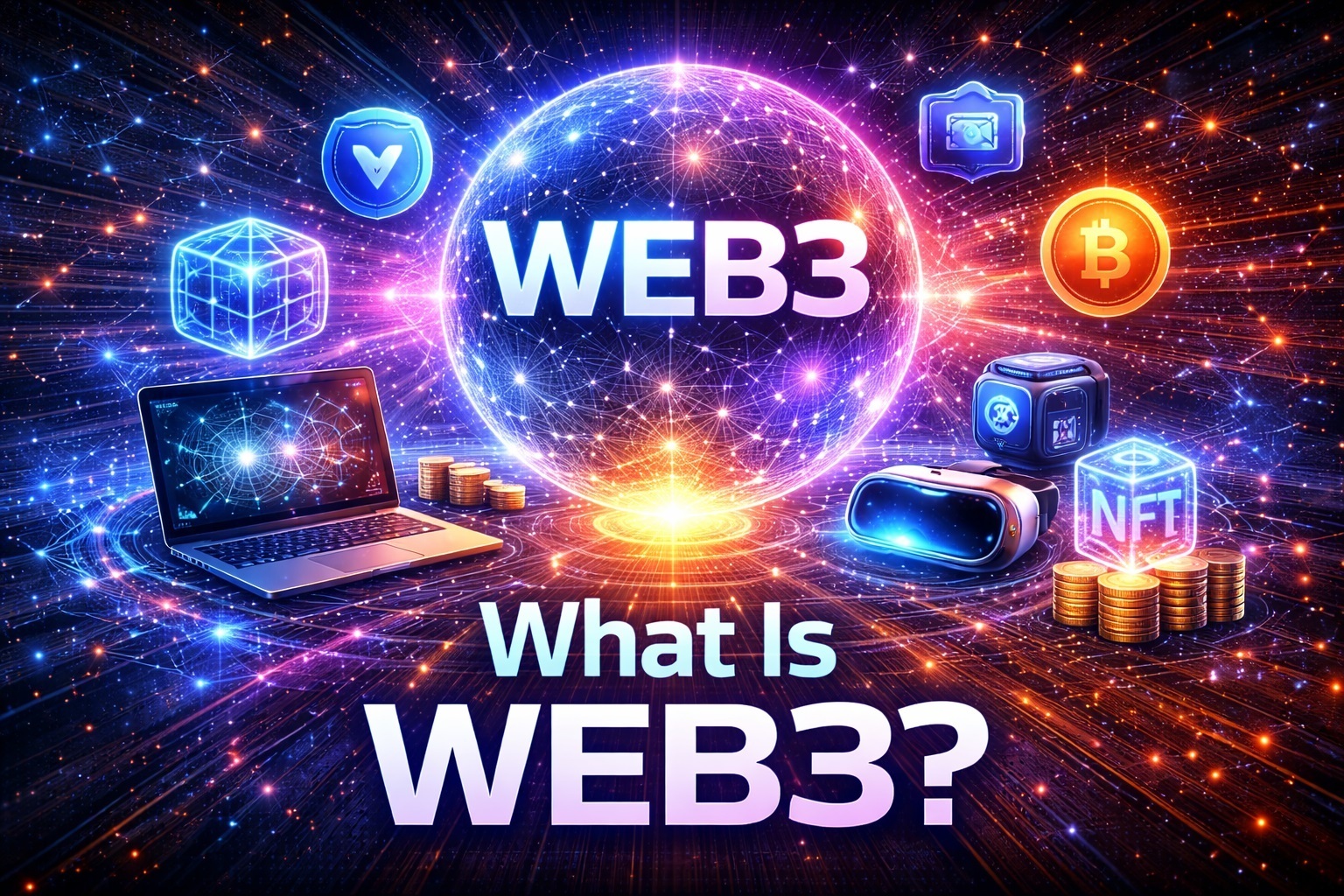

Web3 is the third generation of the internet — a decentralised version built on blockchains, cryptocurrencies, and peer‑to‑peer networks. Unlike Web2 (where platforms like Google, Facebook, and Amazon control your data), Web3 puts ownership and control back in users’ hands. In Web3, you own your digital identity, your assets, and your data. Applications run on blockchains (or similar decentralised networks) without a central company pulling the strings. By 2026, Web3 has moved from hype to practical infrastructure, powering everything from finance (DeFi) to digital art (NFTs) to autonomous organisations (DAOs).
Web1 vs Web2 vs Web3: How Did We Get Here?
The internet has gone through three distinct phases. Web1 was read‑only, Web2 became read‑write, and Web3 adds read‑write‑own.
| Generation | Era | Key characteristics | Example |
|---|---|---|---|
| Web1 | ~1990‑2004 | Static pages, read‑only. Users consume content, no interaction. | Personal blogs, early Yahoo, news sites |
| Web2 | ~2005‑2020 | Centralised platforms, read‑write. Users create content, but platforms own it. | Facebook, YouTube, Twitter, Uber |
| Web3 | ~2021‑present | Decentralised, read‑write‑own. Users own their data, identity, and assets. | Ethereum, Uniswap, OpenSea, DAOs |
Web1 was like a digital library – you could only read.
Web2 gave you the ability to post, like, and share – but the platform owned everything.
Web3 adds ownership using blockchain: your digital items, your identity, your money – truly yours.
What Makes Web3 Different from Web2?
Web3 removes the middleman. Instead of trusting a company to manage your data and transactions, you trust open‑source code and a decentralised network of thousands of computers.
| Aspect | Web2 (Centralised) | Web3 (Decentralised) |
|---|---|---|
| Who owns your data? | The platform (Google, Meta) | You (self‑custody) |
| Who can censor you? | The platform can ban or delete | Almost impossible – network consensus |
| Where is the code? | Proprietary, on company servers | Open source, on blockchain |
| Single point of failure? | Yes – company server can go down | No – network runs on thousands of nodes |
| Payment systems | Banks, PayPal (can freeze) | Crypto wallets (you control) |
| Identity | Email + password (company manages) | Private key (you manage) |
Example: In Web2, if Twitter bans you, you lose your followers and content. In Web3, your social graph lives on a blockchain – no single company can erase it.
What Are the Core Components of Web3?
Web3 is not one thing – it’s a stack of technologies that work together to create a decentralised internet.
1. Blockchain – The Foundation
Blockchain is the decentralised database that records ownership and transactions without a central authority.
- Bitcoin showed you can have digital money without a bank.
- Ethereum added smart contracts – programmable logic that runs on blockchain.
- Cellframe adds post‑quantum security and L0 infrastructure for inter‑chain communication.
2. Cryptocurrencies & Tokens – The Economy
Digital money (coins) and digital assets (tokens) power Web3 transactions and incentives.
- Coins (BTC, ETH, CELL) are native to their blockchains.
- Tokens (USDT, UNI, NFTs) are built on top of blockchains.
- Stablecoins (USDC, DAI) keep a stable value.
3. Smart Contracts – The Code of Web3
Smart contracts are self‑executing programs that run exactly as written, without downtime, fraud, or third‑party interference.
- Example: A smart contract for a rental deposit – automatically refunds when the car is returned undamaged.
- Cellframe alternative: Conditional transactions – similar logic but without smart contract vulnerabilities (no reentrancy bugs, no EVM overhead).
4. DeFi (Decentralised Finance) – Banking Without Banks
DeFi replaces traditional financial services with open protocols that anyone can use.
| Traditional Finance | DeFi Alternative |
|---|---|
| Bank loan | Aave, Compound (borrow against crypto) |
| Stock exchange | Uniswap, Curve (trade tokens) |
| Savings account | Staking, liquidity pools (earn yield) |
| Insurance | Nexus Mutual (peer‑to‑peer cover) |
By 2026, DeFi has grown to over $200 billion in total value locked (TVL), with millions of daily active users.
5. NFTs – Digital Ownership
NFTs (non‑fungible tokens) prove ownership of unique digital items – art, music, in‑game items, even real‑world assets tokenised.
- Art & collectibles: CryptoPunks, Bored Ape Yacht Club
- Gaming: Skins, weapons, land (e.g., Axie Infinity)
- Certificates: Diplomas, tickets, licenses (Cellframe’s CF‑721 standard)
6. DAOs – Organisations Without Bosses
A DAO (Decentralised Autonomous Organisation) is a community‑run entity where rules are encoded in smart contracts. Decisions are made by voting with governance tokens.
- Examples: Uniswap DAO, MakerDAO, ConstitutionDAO (tried to buy a US Constitution copy)
- How they work: Proposals → Token‑holder voting → Automatic execution if passed
7. Wallets – Your Web3 Identity
A Web3 wallet (MetaMask, Cellframe Wallet, Ledger) holds your private keys, which control your crypto, NFTs, and digital identity. You don’t log in with “username/password” – you connect your wallet.
Why Does Web3 Matter? Real‑World Benefits
Web3 shifts power from corporations to individuals. Here’s what that means in practice.
| Problem in Web2 | Web3 Solution |
|---|---|
| Platform bans you – you lose everything | No single entity can censor you |
| You don’t own your data – platforms sell it | You control who accesses your data |
| Cross‑border payments take days and cost high fees | Crypto transfers in minutes for pennies |
| Artists get little from resales (e.g., music streaming) | NFTs give creators royalties on every resale |
| Banks can freeze your account | You control your crypto wallet – no freeze |
Example – Creator royalties: An artist sells an NFT for $1,000. Later it resells for $100,000. With Web2, the artist gets nothing. With Web3, a smart contract can send 10% of every resale back to the creator automatically.
What Are the Challenges Facing Web3 in 2026?
Despite massive progress, Web3 still has real problems that need solving.
| Challenge | Why it matters | How it’s being addressed |
|---|---|---|
| Scalability | Many blockchains (Ethereum) get congested, fees spike | L2 rollups, sharding (Ethereum 2.0), L0 solutions (Cellframe) |
| User experience | Wallets, gas fees, private keys are confusing for non‑tech users | Smart wallets (account abstraction), better onboarding |
| Security | Smart contract hacks, phishing, lost keys | Audits (CertiK), hardware wallets, education |
| Regulation | Governments are still figuring out how to tax and regulate crypto | MiCA (EU), GENIUS Act (US) – clearer rules emerging |
| Quantum threat | ECDSA (used by Bitcoin, Ethereum) will be broken by quantum computers | Post‑quantum cryptography (Cellframe, QRL) |
How Does Cellframe Fit Into Web3?
Cellframe is not a typical Web3 application – it’s infrastructure. Specifically, it’s a Layer‑0 (L0) platform that provides post‑quantum security and interoperability for the entire Web3 ecosystem.
| Cellframe feature | Web3 benefit |
|---|---|
| Post‑quantum cryptography (Falcon, CRYSTALS‑Dilithium) | Web3 assets remain safe after Q‑day – unlike Bitcoin/Ethereum |
| L0 architecture + L1 parachains | Scalable Web3 infrastructure – horizontal scaling via independent chains |
| Upgradable crypto without hard forks | Web3 can evolve without contentious network splits |
| Conditional transactions (instead of smart contracts) | Safer programmable logic – no reentrancy or EVM bugs |
| Cellframe Wallet (CertiK rating “A”) | Secure self‑custody for Web3 users |
In short: Cellframe provides the foundation for a Web3 that is quantum‑resistant, scalable, and upgradeable – addressing three of the biggest challenges facing the decentralised internet in 2026.
Glossary of Web3 Terms
| Term | Definition |
|---|---|
| Web3 | The decentralised internet built on blockchains, where users own their data and assets. |
| Blockchain | A distributed ledger that records transactions across many computers – no central authority. |
| Smart contract | Self‑executing code on a blockchain that automatically enforces agreements. |
| DeFi (Decentralised Finance) | Financial services (lending, trading, saving) built on blockchains without banks. |
| NFT (Non‑Fungible Token) | A unique token representing ownership of a digital or physical item. |
| DAO (Decentralised Autonomous Organisation) | An organisation run by smart contracts and community voting – no CEO. |
| Wallet (Web3) | Software or hardware that holds private keys and lets you interact with blockchains. |
| Private key | A secret code that proves ownership of crypto and NFTs. Never share it. |
| Gas fee | The fee paid to process a transaction on a blockchain (e.g., Ethereum). |
| Layer 0 (L0) | Foundational infrastructure that connects multiple blockchains (e.g., Cellframe). |
| Layer 2 (L2) | Scaling solutions built on top of L1 blockchains to increase speed and lower fees. |
| Stablecoin | A cryptocurrency pegged to a stable asset (e.g., US dollar) to avoid volatility. |
| Post‑quantum cryptography | Algorithms resistant to quantum computer attacks – used by Cellframe. |
| Q‑day | The hypothetical day a quantum computer breaks classical encryption (ECDSA, RSA). |
Summary
Web3 is not just a buzzword – it’s a fundamental shift in how the internet works. Instead of trusting corporations with your data, identity, and money, Web3 replaces trust with cryptographic verification and decentralised consensus.
By 2026, Web3 has matured into a real, usable infrastructure: DeFi handles billions in daily volume, NFTs have created a new digital art economy, and DAOs are running everything from investment funds to social clubs.
Challenges remain – scalability, user experience, security, and the looming quantum threat. But solutions are emerging: L2 rollups, smart wallets, better auditing, and post‑quantum platforms like Cellframe that were built for the next decade.
Whether you’re an investor, developer, or just a curious user, understanding Web3 is no longer optional – it’s the direction the internet is heading.
Want to dive deeper? Start with a wallet (Cellframe Wallet, MetaMask) and try a simple DeFi app or buy an NFT. The best way to learn Web3 is to use it.


Top comments (0)