
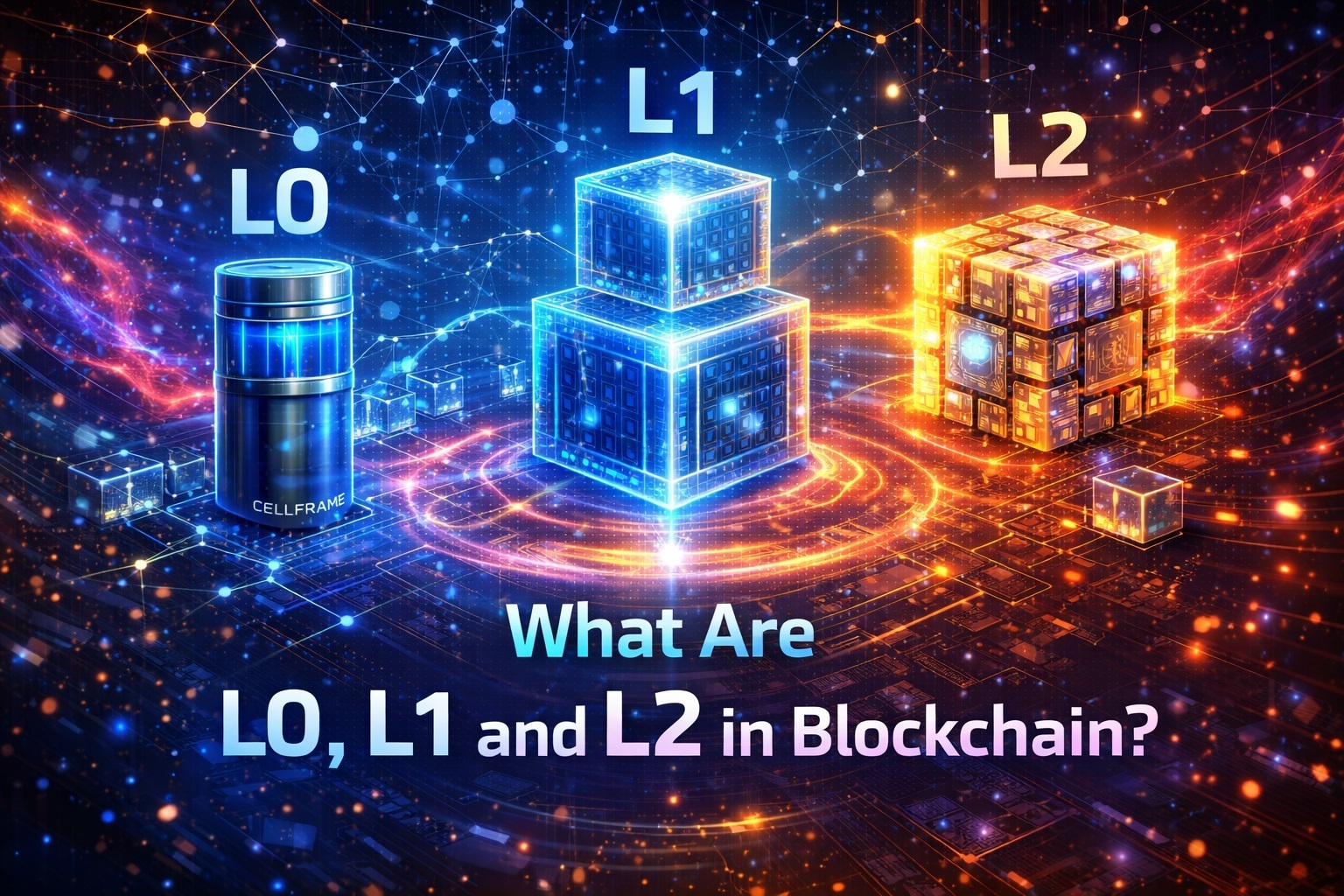

Blockchain architecture is modular. Layer 0 (L0) provides the foundational infrastructure (like a power grid), Layer 1 (L1) is the base blockchain (Bitcoin, Ethereum) handling security and consensus, and Layer 2 (L2) builds on top to make transactions fast and cheap (Lightning Network, Arbitrum). In 2026, the industry has widely adopted this layered model, where L0 protocols (like Polkadot, Cosmos, and Cellframe's mainnet) serve as the "Internet of Blockchains," enabling different networks to interact seamlessly.
Why Is Blockchain Divided Into Layers?
Blockchain is split into layers to solve the "Blockchain Trilemma": the fundamental challenge of achieving security, decentralization, and scalability simultaneously. No single chain can excel at all three, so the industry split responsibilities across layers.
- L0 – The Foundation: Handles interoperability and basic infrastructure, allowing different blockchains to communicate.
- L1 – The Core: Maintains the ledger, executes transactions, and ensures security through consensus (PoW or PoS).
- L2 – The Overpass: Processes transactions off the main chain to boost speed and reduce fees, then settles them back on L1.
Think of a city: L0 is the land and utility grid, L1 is the main roads and buildings, and L2 is the elevated highways that bypass traffic jams.
What Is Layer 0 (L0) and Why Does It Matter?
Layer 0 is the foundational infrastructure that enables different blockchains to be built and, more importantly, to communicate with each other. Unlike L1 chains, an L0 network doesn't host transactions itself — it provides the "Internet of Blockchains" backbone.
Core Functions of L0
- Interoperability: L0 protocols (Polkadot, Cosmos) create standards for different chains to exchange data and assets seamlessly.
- Shared Security: Some L0s (like Polkadot) allow multiple blockchains to share a single validator set, reducing the need for each chain to secure itself independently.
- Developer Tooling: L0 provides SDKs and frameworks (e.g., Cosmos SDK) to launch custom blockchains without rebuilding infrastructure from scratch.
Popular L0 Protocols (2026)
| Protocol | Mechanism | Finality | Key Feature |
|---|---|---|---|
| Polkadot | Nominated PoS | 12-60 sec | Relay chain + parachains; shared security model |
| Cosmos | Tendermint BFT | 1-3 sec | IBC protocol; sovereignty-focused, hub-and-zone model |
| Avalanche | Avalanche Consensus | 1-2 sec | High throughput subnets |
| Celestia | Modular DA | - | Specialized data availability layer |
What Is Layer 1 (L1) in Simple Terms?
Layer 1 is the base blockchain where the actual ledger lives — the "source of truth." This is what most people think of as "a blockchain": Bitcoin, Ethereum, Solana.
What L1 Does
- Transaction Finality: L1 confirms transactions and ensures no one is cheating the system.
- Consensus Mechanism: Defines how participants agree on the state of the ledger (PoW, PoS, etc.).
- Smart Contracts (for some): Platforms like Ethereum execute programmable logic directly on L1.
Key L1 Performance Metrics (2026)
| Blockchain | TPS | Consensus | Weakness |
|---|---|---|---|
| Bitcoin | ~7 TPS | PoW | Slow, expensive during congestion |
| Ethereum | 15-30 TPS | PoS | Gas fees spike under load |
| Solana | ~2,000-3,000 TPS | PoH + PoS | Validator centralization concerns |
The main problem with L1s is that when they get congested, fees skyrocket and speeds plummet — hence the need for L2 solutions.
What Is Layer 2 (L2) and How Does It Work?
Layer 2 is a scaling solution built on top of L1 that processes transactions off the main chain to increase speed and reduce costs, while still relying on L1 for final security. Think of it as building a skyscraper on L1 land — it increases capacity without taking up more space on the ground.
How L2 Works
- Transactions happen off-chain (faster, cheaper).
- L2 periodically "rolls up" batches of transactions and submits them to L1 for final settlement.
- Security is inherited from L1, so users don't have to trust the L2 operator fully.
Popular L2 Examples (2026)
| L2 Solution | Underlying L1 | Technology | Benefit |
|---|---|---|---|
| Lightning Network | Bitcoin | Payment channels | Near-instant micro-payments |
| Arbitrum / Optimism | Ethereum | Optimistic rollups | Low fees, EVM-compatible |
| ZK-Rollups (zkSync, StarkNet) | Ethereum | Zero-knowledge proofs | Fast finality, strong privacy |
But L2 Isn't Perfect
While L2s dramatically improve speed, they introduce trade-offs:
- Not all transactions undergo full verification — some L2s rely on fraud proofs or validity proofs, which can be less battle-tested than L1 consensus.
- Fragmentation risk — moving assets between different L2s and L1s is still a friction point in 2026.
- Centralization concerns — some L2 operators still use multisig bridges instead of fully decentralized mechanisms.
How Does Cellframe Implement L0 and L1 Differently?
Cellframe is designed as a Layer‑0 infrastructure protocol, not just another L1 blockchain. Its mainnet (L0) provides base security and network governance, while independent L1 parachains (services like KelVPN and Backbone) operate on top of this foundation — each with its own rules, economics, and transaction types.
Cellframe's Unique Architecture
| Level | Cellframe's Implementation | Purpose |
|---|---|---|
| L0 (Mainnet) | Quantum-resistant mesh network, post-quantum cryptography (Falcon, Dilithium), upgradable crypto without hard forks | Foundational security and interoperability |
| L1 (Parachains) | Independent service-specific blockchains (e.g., KelVPN, Backbone) running on L0 | Horizontal scalability — services don't interfere with each other |
| L2 (Two-layer sharding — in development) | Dynamic cells (shards) within each L1 blockchain for parallel transaction processing | Vertical scalability — each L1 can split into multiple cells under load |
Key Advantages Over Traditional Models
- No hard forks for upgrades — Cellframe's L0 uses cryptography type identifiers, allowing algorithm updates without breaking compatibility.
- Post-quantum ready — Unlike Bitcoin and Ethereum (ECDSA), Cellframe was built with NIST-approved quantum-resistant algorithms from day one.
- True scalability — While Ethereum uses L2 rollups as an afterthought, Cellframe's L0 + L1 + dynamic sharding architecture was designed for parallel processing from the start.
- Full verification — Unlike many L2 solutions, Cellframe's L1 parachains maintain full transaction verification and decentralization through a validator reputation system.
L0 vs L1 vs L2: The Quick Comparison Table
| Layer | Role | Examples | Who Uses It |
|---|---|---|---|
| L0 | Foundation, interoperability, shared security | Polkadot, Cosmos, Cellframe mainnet | Developers launching new blockchains |
| L1 | Base ledger, consensus, final settlement | Bitcoin, Ethereum, Solana | Everyday users sending transactions |
| L2 | Scaling, speed, low fees | Lightning Network, Arbitrum, Optimism | High-frequency traders, DeFi users |
Glossary of Blockchain Layer Terms
| Term | Definition |
|---|---|
| L0 (Layer 0) | Foundational infrastructure that connects blockchains and enables data transmission between them. In Cellframe, L0 is the mainnet providing base-level security and network governance. |
| L1 (Layer 1) | The base blockchain where the ledger lives. Examples: Bitcoin, Ethereum. In Cellframe, L1 represents parachains that run on the mainnet infrastructure. |
| L2 (Layer 2) | Scaling solutions built on top of L1 that move some operations off-chain to increase speed. Examples: Lightning Network (Bitcoin), Arbitrum (Ethereum). |
| Blockchain Trilemma | The fundamental challenge that networks cannot simultaneously maximize security, decentralization, and scalability. |
| Interoperability | The ability of different blockchains to exchange data and assets seamlessly. |
| Parachain (in Cellframe) | An independent L1 blockchain that operates on the Cellframe mainnet (L0), providing scalability while maintaining security through the underlying L0 infrastructure. |
| Rollup | An L2 technology that bundles multiple off-chain transactions into a single batch and submits them to L1 for settlement. |
Summary
Blockchain layers exist because no single chain can be fast, cheap, and fully decentralized at the same time. The industry solved this by splitting responsibilities: L0 handles interoperability and infrastructure, L1 secures the ledger, and L2 processes transactions at scale.
In 2026, this layered model has matured into the standard for Web3 architecture. Projects like Cellframe take it further: built as an L0 protocol from the ground up, with post-quantum cryptography, upgradable crypto without hard forks, and L1 parachains that scale independently — addressing the trilemma without compromising on security or decentralization.
While Bitcoin and Ethereum rely on external L2 solutions to patch their scalability gaps, Cellframe's architecture was designed for parallel processing from day one, making it quantum-ready and truly modular. Whether you're a developer building the next dApp or an investor evaluating blockchain infrastructure, understanding L0, L1, and L2 is essential for navigating the Web3 ecosystem in 2026.
Updated: April 13, 2026. Information is current as of publication.


Top comments (0)