
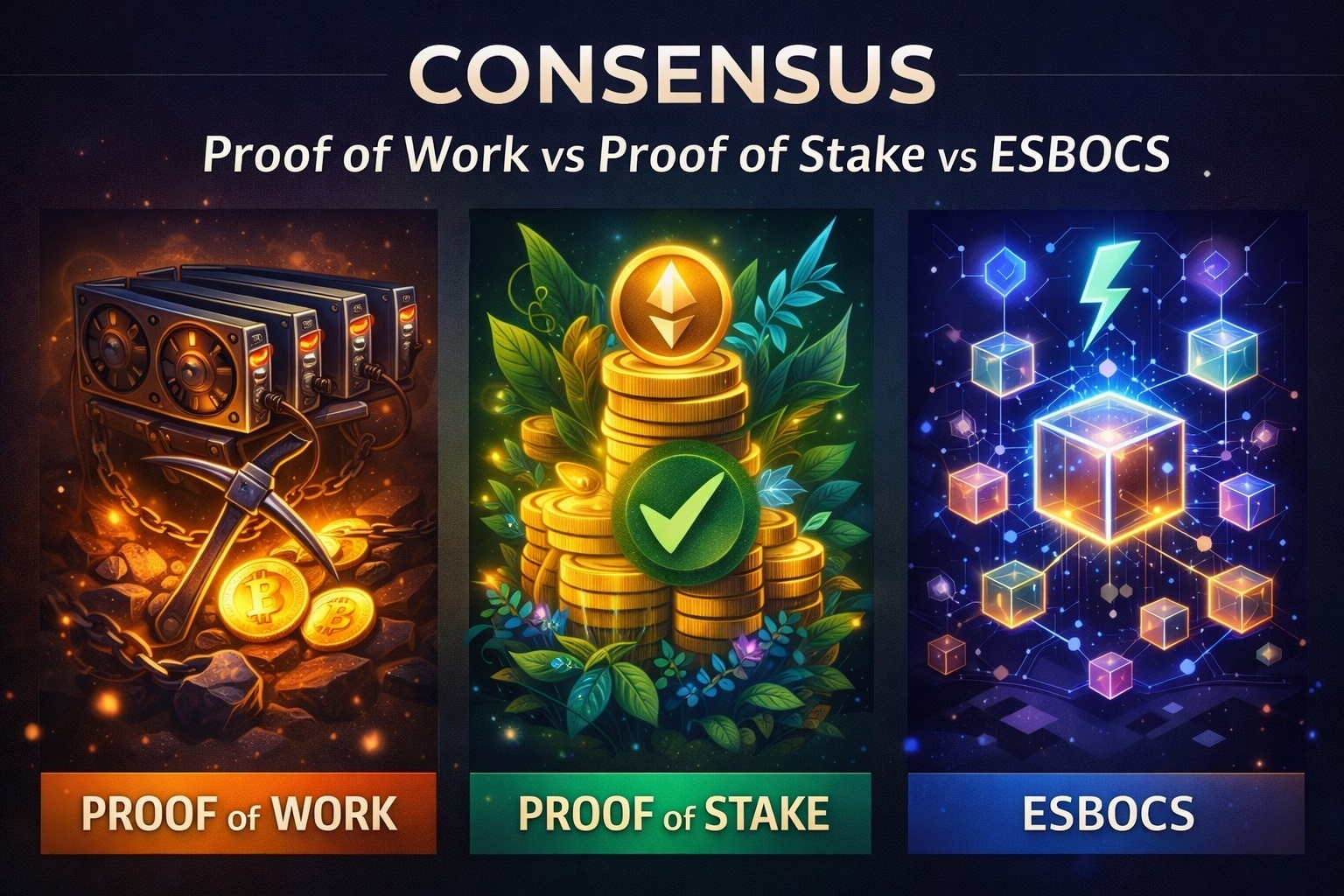

Consensus in blockchain is the mechanism by which all participants (nodes) agree on a single version of the transaction history without trusting a central authority. It’s the “majority rule” coded into the protocol. Without consensus, a blockchain would fragment into conflicting versions. In 2026, the main mechanisms remain Proof‑of‑Work (PoW, Bitcoin), Proof‑of‑Stake (PoS, Ethereum), and their modifications such as ESBOCS (Cellframe), optimised for post‑quantum cryptography.
Why Does Blockchain Need Consensus?
A blockchain is a distributed database with no central boss. Without a central server to decide what’s true, participants must somehow agree. Consensus is that agreement protocol.
Imagine a group of people keeping a shared ledger of debts. If one says “You owe me $10” and another says “No, only $5”, you need a way to settle the dispute. In blockchain, that way is a mathematical algorithm that:
- Ensures immutability – the history cannot be forged.
- Prevents double‑spending – the same coin cannot be sent twice.
- Allows the network to function without a central bank or administrator.
What Are the Main Types of Consensus?
In 2026, three families dominate: Proof‑of‑Work (proof of work), Proof‑of‑Stake (proof of stake), and hybrid/modified versions such as ESBOCS.
1. Proof‑of‑Work (PoW) – Proof of Work
How it works:
Miners collect transactions from the mempool into a candidate block. Then they compete: who can find a nonce (a random number) such that the block’s hash is below a target value. The first to solve the puzzle broadcasts the block; others verify and start hunting for the next.
| Feature | Value |
|---|---|
| Energy consumption | Very high (Bitcoin uses as much as a small country) |
| Speed | Slow (Bitcoin block ~10 minutes) |
| Security | High – requires >51% of total network hashrate |
| Example | Bitcoin, Litecoin, Dogecoin |
Pros: Decades‑proven security, full decentralisation, neutrality.
Cons: Massive energy use, slow transactions, mining industrialised (home GPUs can’t compete).
2. Proof‑of‑Stake (PoS) – Proof of Stake
How it works:
Validators lock (stake) their coins as collateral. The algorithm randomly selects one validator to propose the next block. Other validators check the block and vote (attestation). If the block gets >2/3 votes, it is added to the chain. Honest validators earn rewards; cheaters get slashed (part of their stake is burned).
| Feature | Value |
|---|---|
| Energy consumption | Minimal (Ethereum cut energy use by 99.95% after switching to PoS) |
| Speed | Fast (blocks in seconds) |
| Security | Economic – attack requires >51% of all staked coins |
| Example | Ethereum (post‑Merge), Cardano, Solana |
Pros: Energy efficient, fast, low entry barrier (regular computer).
Cons: Centralisation risk among large holders, operational risks (offline nodes can be penalised).
3. ESBOCS (Extended Stochastic Bound Consensus) – Modified PoS for the Post‑Quantum Era
How it works:
ESBOCS is a PoS variant developed for Cellframe. Key differences:
- Only a small random group of validators (up to 10) signs the block. This keeps blocks light and fast.
- Uses post‑quantum signatures (CRYSTALS‑Dilithium, Falcon, SPHINCS+). Even a quantum computer cannot forge a signature.
- Dynamic committee rotation – the validating group constantly changes, preventing collusion.
- Works with two‑layer sharding – parallel transaction processing across different cells.
| Feature | Value |
|---|---|
| Energy consumption | Minimal (like PoS) |
| Speed | Very high (seconds, plus horizontal scaling) |
| Security | Post‑quantum + economic |
| Example | Cellframe (L0 + L1 parachains) |
Pros: Post‑quantum protection, upgradable cryptography without hard forks, scalability.
Cons: Newer technology, less battle‑tested than PoW.
PoW vs PoS vs ESBOCS Comparison Table
| Criterion | PoW (Bitcoin) | PoS (Ethereum) | ESBOCS (Cellframe) |
|---|---|---|---|
| Who creates the block | Miner who solves the puzzle first | Randomly selected validator | Randomly selected validator from a small committee |
| Energy cost | Enormous | Negligible | Negligible |
| Block time | ~10 minutes | ~12 seconds | ~1‑2 seconds (within a shard) |
| Quantum protection | No (ECDSA) | No (ECDSA) | Yes (Falcon, Dilithium) |
| Cryptography upgrade | Only via hard fork | Only via hard fork | Via algorithm IDs – no forks |
| Scalability | Low (single chain) | Medium (L2 + data sharding) | High (two‑layer sharding) |
What Is Byzantine Fault Tolerance (BFT)?
Byzantine Fault Tolerance is the ability of a system to continue operating correctly even if some nodes behave maliciously or send contradictory information.
The name comes from the “Byzantine Generals Problem”: several generals besiege a city; they must agree on an attack plan, but some generals may be traitors sending false messages. In blockchain, nodes are the generals, and potential attackers are the traitors.
Most modern consensus algorithms (including PoS and ESBOCS) are Byzantine fault‑tolerant. This means the network can reach agreement even if up to 1/3 (or up to 1/2 in some models) of nodes act incorrectly.
What Is Slashing and Why Is It Needed?
Slashing is a penalty mechanism in PoS networks: if a validator breaks the rules (e.g., signs two conflicting blocks or goes offline too often), part of their staked coins is burned.
Why it matters:
- Economically incentivises honest behaviour – cheating becomes unprofitable.
- Improves network security – an attack would require a huge stake that would be destroyed upon attempt.
In Cellframe, slashing is also implemented, adapted for post‑quantum cryptography.
Which Consensus Should You Choose for Your Project?
The choice depends on your priorities: maximum security and proven track record → PoW. Speed, energy efficiency, and decentralisation → PoS. A future with post‑quantum protection and scalability → ESBOCS or similar.
| If you need | Recommended consensus |
|---|---|
| Digital gold, maximum security, speed not critical | PoW (Bitcoin) |
| Fast transactions, green network, DeFi, millions of users | PoS (Ethereum, Solana) |
| Protection against quantum computers, scalability, upgradeability without forks | ESBOCS (Cellframe) |
Glossary
| Term | Definition |
|---|---|
| Consensus | The mechanism by which blockchain nodes agree on the state of the ledger. |
| Proof‑of‑Work (PoW) | A consensus that requires computational work to create a block. |
| Proof‑of‑Stake (PoS) | A consensus where the right to create a block is determined by the amount of staked coins. |
| ESBOCS | Cellframe’s modification of PoS with post‑quantum signatures and small validator groups. |
| Validator | A participant in a PoS network who checks transactions and signs blocks. |
| Miner | A participant in a PoW network who solves cryptographic puzzles to create blocks. |
| Staking | The process of locking coins to participate in PoS consensus. |
| Slashing | A penalty (burning part of the stake) for a validator that misbehaves. |
| Nonce | A one‑time number that miners iterate in PoW to find a valid hash. |
| Attestation | A validator’s vote in PoS confirming the correctness of a block. |
| Byzantine Fault Tolerance (BFT) | The ability of a network to function despite malicious nodes. |
| Post‑quantum cryptography | Algorithms resistant to quantum computer attacks (Falcon, Dilithium). |
Summary
Consensus is the heart of any blockchain. Without it, there would be no Bitcoin, no Ethereum, no decentralised applications. In 2026, we see three main approaches: time‑tested PoW (reliable but energy‑intensive), modern PoS (fast and green), and next‑generation systems like ESBOCS (post‑quantum secure + scalable).
Cellframe chose ESBOCS not because it is trendy, but because the future demands resilience to quantum threats. While other networks discuss migration, Cellframe already runs on NIST‑approved algorithms with the ability to upgrade cryptography without hard forks.
Want to go deeper? Explore Cellframe’s consensus documentation or try running a test node.



Top comments (0)