
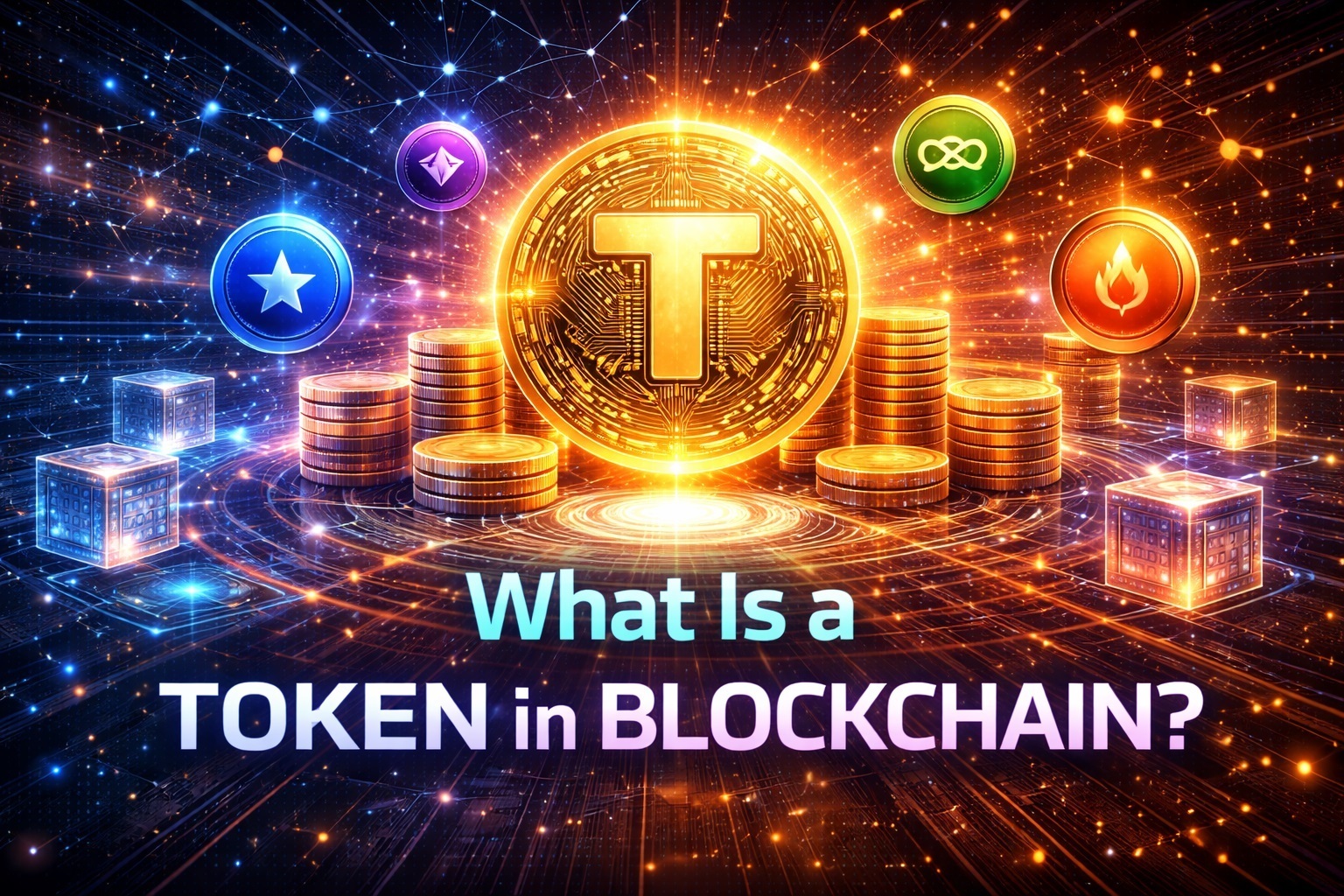

A token is a digital unit of account that lives on a blockchain and can represent anything: money, shares, voting rights, access to a service, or even a unique digital object (like a painting or a game sword). Unlike a coin (e.g., Bitcoin or CELL), which is the native currency of its own blockchain, a token is created on top of an existing blockchain using smart contracts or built‑in mechanisms. In 2026, tokens underpin the entire crypto economy — from decentralised finance (DeFi) to digital collectibles and corporate registries.
How Is a Token Different from a Coin?
The main difference: a coin is the native currency of a blockchain, needed to pay fees and secure the network. A token is created on top of a blockchain and is not required for the blockchain itself to function.
| Feature | Coin | Token |
|---|---|---|
| Exists on its own | Yes – it has its own blockchain | No – it lives on another blockchain |
| Examples | Bitcoin (BTC), Ethereum (ETH), CELL | USDT (on Ethereum), BAYC (NFT), UNI |
| Pays fees | Yes – fees are paid in the coin | No – fees are paid in the base blockchain’s coin |
| Creation | Requires building a new blockchain | Via smart contract or built‑in mechanism |
| Time to create | Months or years | Minutes or hours |
Example: USDT (Tether) is a token on the Ethereum blockchain. To send USDT, you pay a fee in ETH (Ethereum’s coin). USDT itself does not have its own blockchain.
What Are the Main Types of Tokens?
In 2026, tokens fall into three main categories: fungible, non‑fungible (NFT), and utility. Each type serves different purposes.
1. Fungible Tokens
These are tokens where every unit is identical to another and can be exchanged. Like dollars: one dollar always equals another dollar.
| Standard | Blockchain | Examples | Use case |
|---|---|---|---|
| ERC‑20 | Ethereum | USDT, UNI, LINK | DeFi, stablecoins, governance |
| BEP‑20 | BNB Chain | CAKE, BUSD | Similar to ERC‑20 but on BNB Chain |
| CF‑20 | Cellframe | Service tokens on Cellframe | Post‑quantum tokens resistant to quantum attacks |
Example use case: You issue a “CoffeeShopCoin” token. Each token represents the right to one cup of coffee. All tokens are identical; they can be sent, sold, or gifted.
2. Non‑Fungible Tokens (NFTs)
These are tokens with a unique identifier – they cannot be exchanged one‑to‑one. Each NFT is unique.
| Standard | Blockchain | Examples | Use case |
|---|---|---|---|
| ERC‑721 | Ethereum | CryptoPunks, Bored Ape Yacht Club | Digital art, collectibles |
| ERC‑1155 | Ethereum | Game items (Splinterlands) | Semi‑fungible – game resources |
| CF‑721 (analogue) | Cellframe | Post‑quantum NFTs | Certificates, diplomas, asset rights |
Example use case: You create an NFT “Cellframe University Diploma”. Each diploma has its own number, graduate name, issue date. They cannot be swapped one‑for‑one – each is unique.
3. Utility Tokens
These tokens grant access to specific functions or services within an ecosystem. They should not be seen as investments – they are meant to be used.
| Example | Ecosystem | What it gives |
|---|---|---|
| FILE | Filecoin | Payment for decentralised file storage |
| LINK | Chainlink | Payment for oracle services (real‑world data) |
| mCELL | Cellframe | Right to run a master node or delegate to a validator |
Important distinction: A utility token does not give ownership rights in the project. It is simply a “chip” to pay for a service.
How Are Tokens Created?
Tokens are created via smart contracts (on Ethereum and compatible networks) or through built‑in mechanisms (as in Cellframe).
On Ethereum (via smart contract)
- A developer writes a smart contract in Solidity that implements the ERC‑20 standard.
- The contract is deployed to the Ethereum blockchain (requires gas paid in ETH).
- Any user can interact with the contract: check balances, transfer tokens, call functions.
Pros: Simplicity, huge ecosystem, wallet compatibility (MetaMask, etc.).
Cons: Smart contract vulnerabilities, high Ethereum fees, no post‑quantum protection.
On Cellframe (via native mechanism)
- A developer uses the Cellframe SDK (C language) to create their own L1 blockchain or token.
- The token (CF‑20) is created as a built‑in entity – no separate smart contract.
- Security is provided by post‑quantum cryptography (Falcon, CRYSTALS‑Dilithium).
Pros: Post‑quantum protection, low fees, scalability via sharding.
Cons: Fewer ready‑made tools than Ethereum.
What Are Governance Tokens?
Governance tokens give holders voting rights in decentralised organisations (DAOs). The more tokens you hold, the more votes you have.
| Project | Token | What you can vote on |
|---|---|---|
| Uniswap | UNI | Fee tiers, new versions, grants |
| Compound | COMP | Interest rates, adding new assets |
| Aave | AAVE | Lending parameters, protocol upgrades |
Important: A governance token is not a share. It does not entitle you to company profits (unless explicitly stated). It is a community coordination tool.
What Are Stablecoins?
A stablecoin is a token whose price is pegged to a real‑world asset (usually the US dollar). It is used to avoid crypto market volatility.
| Type | Example | How it works | Risks |
|---|---|---|---|
| Fiat‑backed | USDT, USDC | 1 token = 1 dollar in a bank | Trust in the issuer |
| Crypto‑backed | DAI | Backed by other crypto assets (over‑collateralised) | Complexity, liquidation risk |
| Algorithmic | UST (collapsed in 2022) | Algorithm maintains the peg | Historically unreliable |
In 2026, stablecoins facilitate over $46 trillion in annual transactions – three times Visa’s volume.
How Are Tokens Used in Cellframe?
In the Cellframe ecosystem, there are two main token types: CELL (native coin) and mCELL (staking token). Developers can also create their own CF‑20 tokens with post‑quantum protection via the SDK.
CELL – native coin
| Feature | Description |
|---|---|
| Type | Coin (not a token) – Cellframe’s own blockchain currency |
| Purpose | Pay fees, stake, participate in governance |
| Quantum protection | Yes – Falcon/Dilithium signatures |
| Staking | Can be staked in the native network to receive mCELL |
mCELL – staking token
| Feature | Description |
|---|---|
| Type | Utility token (received when staking CELL) |
| Purpose | Right to run a master node or delegate to a validator |
| Special property | Not freely transferable – tied to the stake |
CF‑20 – post‑quantum token standard
Any developer can create their own token on Cellframe that is:
- Quantum‑resistant (Falcon/CRYSTALS‑Dilithium signatures)
- Runs on a sharded architecture (high throughput)
- Compatible with Cellframe Wallet
How to Store Tokens Safely?
Best practice in 2026: keep 80–90% of tokens in a hardware wallet (cold storage) and 10–20% in a software wallet for active trading. For Cellframe tokens, use Cellframe Wallet (CertiK “A” rating).
| Wallet type | Examples | Security | Best for |
|---|---|---|---|
| Hardware | Ledger, Trezor | High (keys offline) | Large amounts of any token |
| Software | MetaMask, Cellframe Wallet | Medium | Active trading, small amounts |
| Exchange | Binance, Gate.io | Low (not your keys) | Trading only |
Glossary
| Term | Definition |
|---|---|
| Token | A digital unit of account created on top of a blockchain. Can represent money, assets, access rights. |
| Coin | The native currency of a blockchain, needed to pay fees and secure the network. |
| Fungible token | A token where every unit is identical to another (like dollars). Example: USDT, UNI. |
| NFT (Non‑Fungible Token) | A token with a unique identifier that cannot be exchanged one‑to‑one. Example: digital artwork. |
| ERC‑20 standard | The technical standard for fungible tokens on Ethereum. |
| CF‑20 | The standard for post‑quantum fungible tokens on Cellframe. |
| Stablecoin | A token pegged to a real‑world asset (usually the dollar) to avoid volatility. |
| Governance token | A token that gives voting rights in a decentralised organisation (DAO). |
| Utility token | A token that grants access to services or functions within an ecosystem. |
| mCELL | Cellframe’s staking token, received when locking CELL. Gives the right to run a master node or delegate. |
| Smart contract | A program that automatically executes the terms of an agreement on the blockchain. Used to create tokens on Ethereum. |
| Post‑quantum protection | The use of algorithms (Falcon, Dilithium) resistant to quantum computer attacks. |
Summary
A token is the fundamental unit of the crypto economy. It can be money (stablecoin), voting power (governance token), access to a service (utility token), or a unique asset (NFT).
In 2026, tokens are used everywhere – from decentralised finance to corporate registries and digital collectibles. Standards like ERC‑20 (Ethereum) and CF‑20 (Cellframe) ensure compatibility and security.
Cellframe offers a unique advantage: all CF‑20 standard tokens are protected by post‑quantum cryptography. While tokens on Ethereum and Bitcoin remain vulnerable to future quantum computers, Cellframe already runs on NIST‑approved Falcon and CRYSTALS‑Dilithium.
If you want to create tokens that stay secure for 10–20 years, look at post‑quantum platforms like Cellframe. If you need maximum compatibility and the largest ecosystem today, Ethereum remains the de‑facto standard. The best strategy is to understand both worlds and choose the right tool for the job.


Top comments (0)