
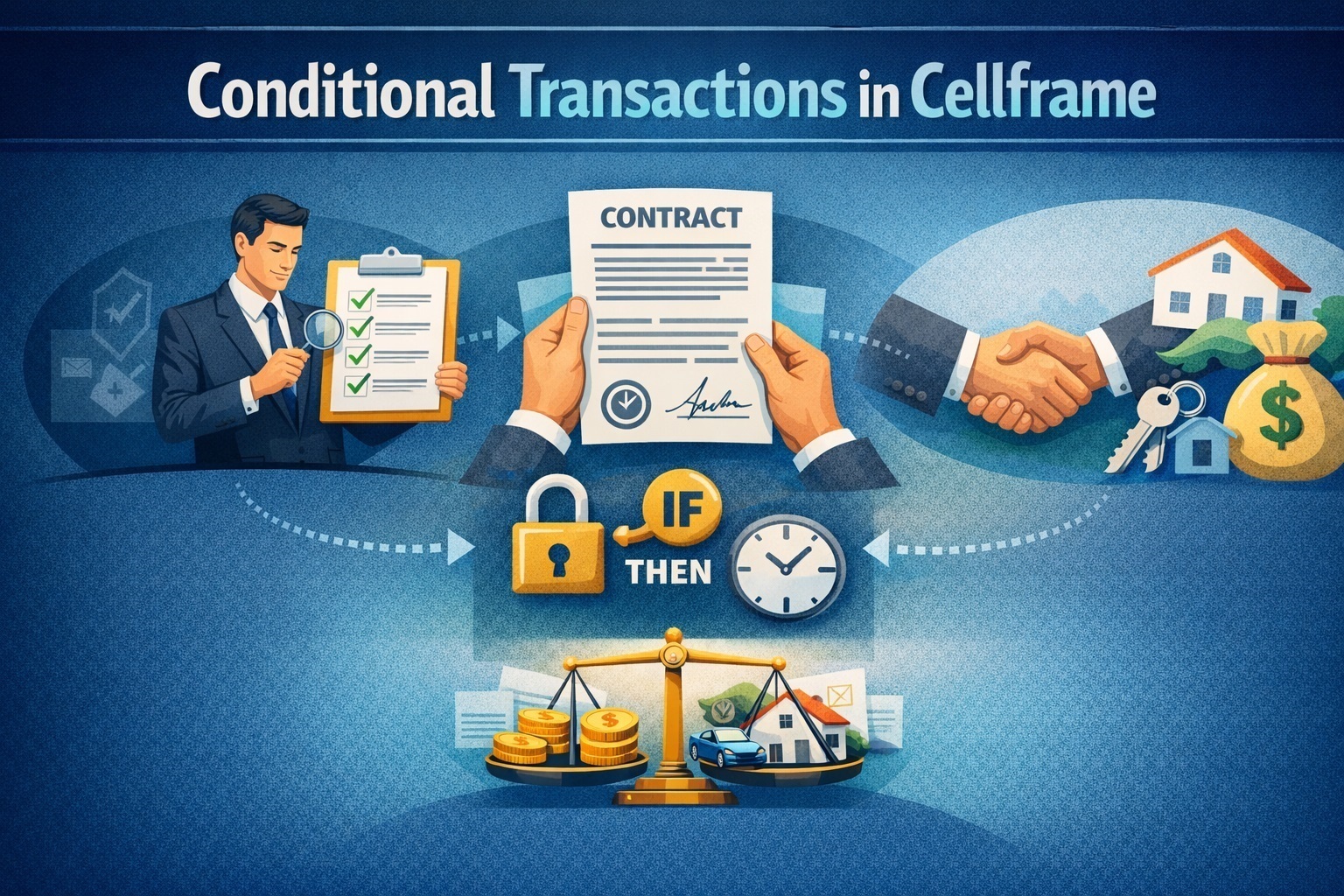

Hey. If you’ve heard about smart contracts on Ethereum but think that’s the only way — here’s an alternative. In Cellframe, instead of smart contracts, we use conditional transactions. Simpler, faster, and no virtual machine.
🤔 What Is a Conditional Transaction?
Basically, it’s a regular transaction with one critical twist: funds can only be spent when a predefined condition is met.
Imagine you put money in an envelope, stick a note on it that says “give only after my pizza is delivered,” and hand the envelope to a third party. In blockchain, the network itself plays the role of that third party. No one can take the money early or cheat the condition.
Conditional transactions can be single, or they can form chains — where the output of one transaction becomes the input for the next.
⚙️ How It Works in Practice
A typical interaction follows this pattern:
Step 1. The customer creates the initial transaction
Even before finding a service provider, the customer “locks” their funds in a conditional transaction. Inside it, they specify the conditions under which they’re willing to exchange the funds for a service.
Step 2. The provider creates a counter‑transaction
Once a provider agrees to meet the conditions, they create a second conditional transaction. This allows them to receive part or all of the locked funds — but only after the condition is actually fulfilled.
If the customer locked more funds than needed for one service, the remainder can:
pay for future services from the same provider,
go to a different provider,
be returned to their wallet.
No middlemen. Everything automatic, everything transparent.
🆚 How It Differs from Smart Contracts
In Ethereum, business logic is encoded in a smart contract — a piece of code uploaded to the blockchain and executed by the Ethereum Virtual Machine (EVM). That offers flexibility, but the contract has an owner, an address, and therefore a potential point of centralization.
In Cellframe, conditional transactions are a built‑in protocol‑level mechanism. They don’t need a virtual machine, they don’t require a separate language (like Solidity), and they don’t introduce extra points of failure. The result:
lower fees,
fewer attack surfaces,
faster execution.
🧩 Where It’s Already Used
Conditional transactions aren’t “raw tech for geeks.” They’re already live in the ecosystem:
Cellframe DEX
Instead of AMM protocols and smart contracts, the exchange uses a limit‑order model. Each order is itself a conditional transaction that holds the exchange terms.Master node delegation
When you delegate your m‑tokens to a validator, that’s done through a chain of conditional transactions.Validator rewards
Distributing rewards for block signing also relies on this mechanism.Service payments
Any model where you “lock first, then get the service, then the funds are released” is a perfect fit for conditional transactions.
🧠 Why This Matters
In traditional blockchains, smart contracts are both a strength and a weakness. Strength — flexibility. Weakness — every contract is written from scratch, may contain bugs, requires auditing, and runs on a virtual machine, which is slow and expensive.
Conditional transactions in Cellframe offer a different path: standardized, predictable, and native. Instead of “write your own code,” it’s “use the built‑in mechanism.” Instead of the EVM, it’s direct execution on nodes. Instead of reentrancy risks and buffer overflows, it’s clear, battle‑tested logic.



Top comments (0)